Chapter Ten: The Math
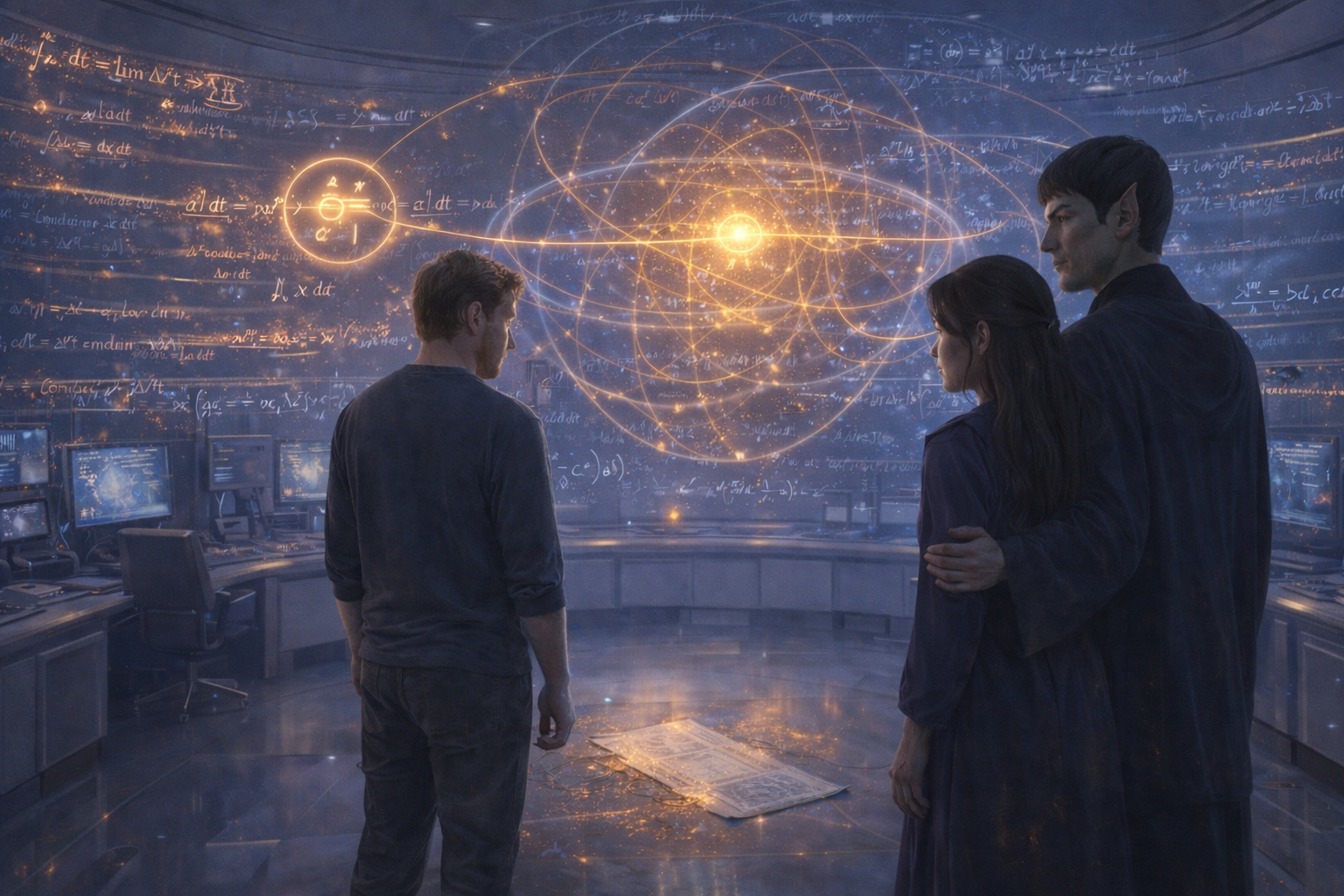
D’Kar was waiting for them. The data module had been transmitting the Guardian’s scope data to his laboratory in real-time since Wesley activated it, and D’Kar had been running models with it for what amounted to days in his timeline. The displays that had once held theoretical projections now held the full picture — every source of temporal energy mapped and measured simultaneously across all of time, rendered in the precise mathematical language that his colleagues had spent years calling speculation.
He looked different than the last time Wesley had seen him. The composure was still there but it was working harder, carrying more weight than it was designed for. Whatever the complete model had shown him, it had cost him something to look at.
Kore crossed the laboratory to D’Kar and stood near him, not touching, just present. D’Kar glanced at her and something behind his control settled slightly. Wesley watched that and understood it was none of his business.
D’Kar walked Wesley through the complete model the way a doctor walks a patient through a diagnosis — carefully, making sure each piece was understood before moving to the next.
The total accumulated energy from all sources across all of time. The threshold below which the Entity could no longer sustain its own growth. The gap between where the Entity was and where it needed to be. The gap was large, and removing one source — even a significant one — wouldn’t be enough on its own. The Temporal Cold War’s contributions were already consumed. The Travelers who’d dissolved had stopped contributing but their historical energy was in the system. Future Guy’s manipulations were massive but removing Jake’s energy alone wouldn’t close the gap because the base was too broad.
Wesley asked what would close it. D’Kar showed him. The model identified one configuration that worked — the removal of a variable whose contributions were consistent, sustained, and distributed across enough moments to create a measurable reduction when subtracted from every point in time simultaneously. Wesley’s interventions averaged 1.6 per event, individually small compared to Future Guy’s 17.8, but Wesley had been intervening constantly since the Kelvin and because he existed outside linear time his removal would subtract those contributions from every moment at once. D’Kar didn’t say Wesley’s name. The math identified the variable by its properties, and the properties described only one being in the timeline.
Wesley pushed back. He asked about natural dissipation. D’Kar had run it — negligible compared to the accumulated mass. He asked about stopping all intervention from every source. D’Kar had run that too — it would slow the growth but not reverse it. He asked about removing Jake instead, since Jake’s output was more than ten times Wesley’s rate. D’Kar showed him that model — Jake’s removal got the Entity closer to threshold but not below it. He asked about removing both of them. D’Kar told him it was redundant — Wesley’s removal alone was sufficient.
Wesley stared at the model and asked D’Kar one more time if there was any other way. D’Kar’s composure cracked — a fraction of a movement in his jaw, barely visible. He told Wesley the mathematics were elegant and terrible, and he couldn’t finish the sentence after that. Kore put her hand on D’Kar’s arm and whatever passed between them in that moment was private enough that Wesley turned away.
Wesley told D’Kar he wasn’t ready to accept that. He wanted to try stepping back first — stopping all intervention, giving the timeline a chance to stabilize without adding more energy. D’Kar told him the models predicted stepping back would slow the growth but not reverse it. Wesley said he wanted to try anyway. D’Kar nodded with the patience of a scientist who understood that the patient needed to see for himself.
Wesley went back to the timeline and stopped reaching into it. Maintained the way he’d maintained for thirty years before the Kelvin — attending without acting, present without pressing. Kore sat with him and maintained alongside him the way they used to.
There was a girl on a colony world that Wesley had been maintaining around for years — a teenager who reminded him of himself at that age, curious about everything, asking questions the adults around her didn’t want to answer. He’d watched her grow up the way a Traveler watches anything, from outside, attending to the moments that shaped her without reaching in.
Jake had found her too. Wesley could see the manipulation — Jake’s signature pressing against her curiosity, narrowing it, steering her away from the questions that would lead her somewhere dangerous. In Jake’s calculus she was better off not knowing, safer in ignorance, protected from the consequences of the answers she was looking for.
Wesley stood in the space between her moment and the next one and did nothing. He watched Jake’s pressure close around her options and he felt every Traveler instinct he had screaming at him to widen the space, and he didn’t move. The girl stopped asking the question. Went back to her life. Accepted the narrower version of her future without knowing a wider one had existed.
Wesley felt something break inside him that wasn’t perception or temporal mechanics or any of the abstract things that had been breaking since the Entity shattered his senses. This was simpler and worse. This was watching a specific person he cared about lose something she’d never know she lost, and choosing to let it happen because helping would feed the thing that was eating everything. And the dead spots kept spreading. D’Kar had told him this would happen. Wesley had chosen not to believe it. Stepping back changed nothing.
He went back to Kore. She looked at him and saw what stepping back had cost him — the damage to the last thing he’d been holding onto, the hope that there was a version of this where he got to keep existing. He told her it didn’t work. She told him she’d known it wouldn’t.
She told him there was a difference between stepping back and what D’Kar’s math was describing. Stepping back meant Wesley still existed, still occupied the space between moments, still carried the entanglement with every moment he’d touched since the Kelvin. His existence was a weight on the timeline whether he acted or not — not because of what he was doing but because of what he’d already done. D’Kar’s math wasn’t asking him to step back. It was asking him to step out.
Wesley worked through what that actually meant. If he was erased, his interventions since the Kelvin would unmake themselves. Every moment he’d widened, every manipulation he’d countered — gone. The Entity would lose his temporal energy and drop below threshold.
But the Kelvin rift was Jake’s work. Jake had engineered it. And if Wesley was erased, the dynamic between them — the push and counter-push that had driven Jake to escalate — would never have existed. Without Wesley as an opponent, Jake’s path changed. Without the escalation, Jake would never have reached the level of manipulation that produced the Kelvin rift in the first place.
Wesley’s erasure wouldn’t just remove his energy from the Entity. It would remove the escalation dynamic that drove Jake to his worst extremes. Without Wesley to fight, Jake never pushes hard enough to engineer the Kelvin rift. The rift was never created. The Prime stays intact.
But Jake still hurts. Still loses his father to the Prophets. Still carries the grief, still studies temporal mechanics, still becomes some version of Future Guy. A less extreme version — intervening at a lower level, feeding the Entity but not enough to push it past the self-sustaining threshold. D’Kar’s math accounted for a still-active Jake. It was Wesley’s consistent, distributed contributions across all moments that tipped the balance, not Jake’s larger but less sustained ones. Remove Wesley and the Entity feeds but doesn’t reach critical mass. The erasure doesn’t fix Jake — nothing fixes Jake except Jake. It just stops making Jake’s path worse by removing the opponent that drove the escalation.
Wesley sat with the strange mathematics of that — his sacrifice removing the need for his biggest sacrifice while leaving everything else wounded and uncertain. The Federation he loved would keep reaching. Jake would keep hurting. Sisko would keep waiting. And whether Jake ever found his way home was between Jake and his father, not something Wesley’s erasure could guarantee. Beverly would never have had a first son. No one would notice the gap.
Wesley’s hands started shaking — not from cold or exhaustion but the way they shake when the body understands something the mind is still trying to negotiate with. He sat with it for a long time. Kore sat with him and let the weight fill the silence. Wesley told Kore he wasn’t saying yes. She told him she knew. He told her he wasn’t saying no either. She knew that too.