Chapter Eleven: Beverly
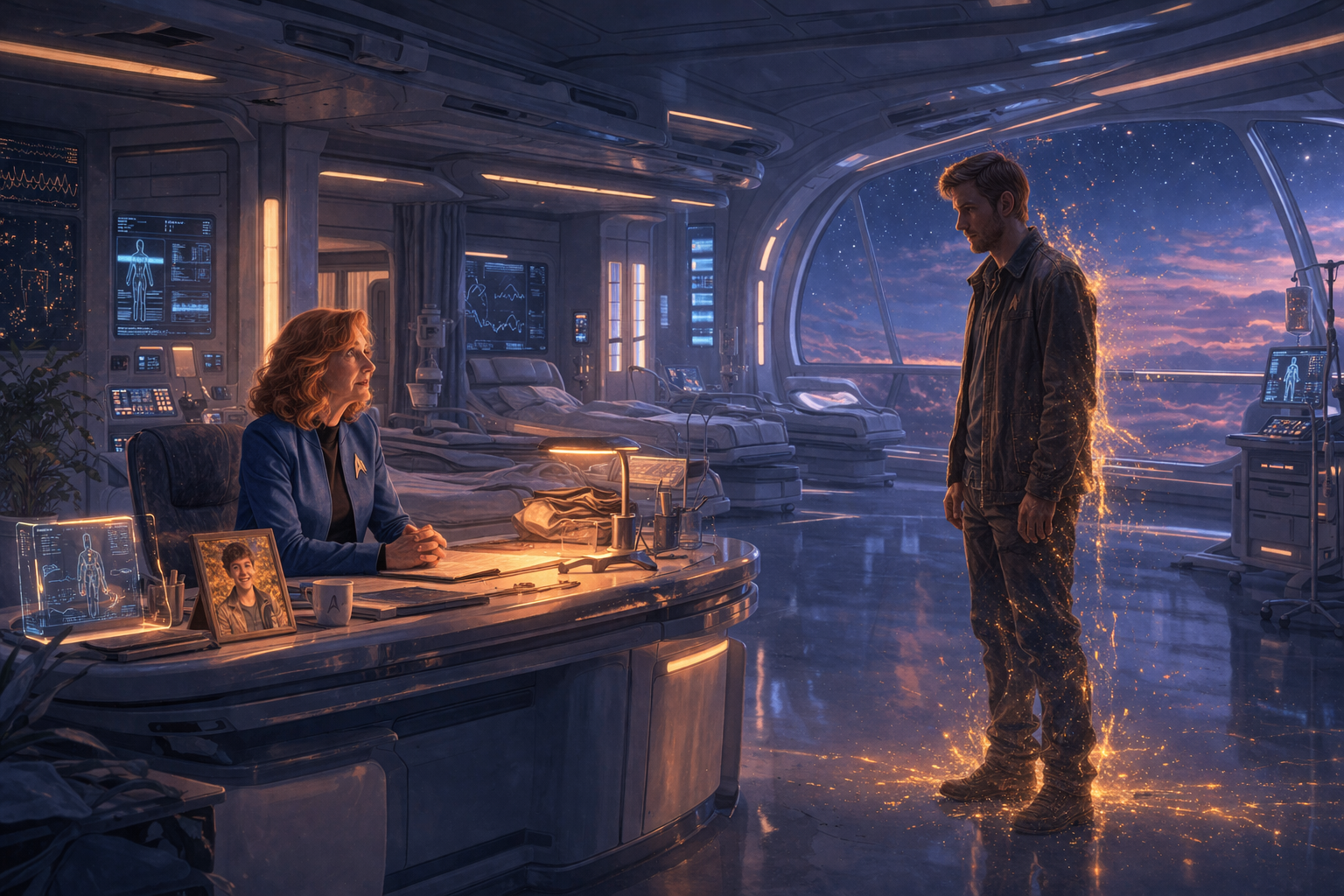
Before he could say goodbye he needed to see her one more time without being seen. He didn’t analyze why. Didn’t construct a justification about gathering emotional data or assessing the cost in concrete terms. He just needed to stand in the same room as his mother and remember what it felt like to be near someone who loved him, before he became someone who had never existed.
Beverly was in sickbay. Late. The kind of late that happens when going back to your quarters means being alone with the silence, and the silence has gotten louder over the years.
The Enterprise — not the one Wesley had served on but the one that carried his mother now — was quiet at this hour. The day shift had cycled out, the emergencies had been handled, the patients who needed monitoring were being monitored by systems that didn’t need sleep. There was no reason for the Chief Medical Officer to be running tests at this hour. She was running them anyway.
Wesley stood in the corner of sickbay and watched her. Close enough to see the grey in her hair that hadn’t been there when he left. Close enough to see the lines around her eyes that mapped the years he’d missed — the patients, the crises, the losses, the mornings she’d woken up and gone to work because that’s what Beverly Crusher did.
On her desk, half-hidden behind a stack of PADDs and a cold cup of something she’d forgotten to drink, there was a photograph. Him. Sixteen. Academy uniform. The smile of a boy who thought the future was something you walked into, not something that walked away from you. She glanced at it while she worked. Not consciously — the way you glance at something that’s been on your desk so long it’s become part of the furniture. But Wesley saw the glance land, saw the micro-pause in her hands, saw the fraction of a second where Beverly Crusher wasn’t the Chief Medical Officer or the researcher or the professional. She was a mother whose son had left and never fully come back. She said his name. Not to anyone. Just to the room. The way you say a word to keep it alive.
Wesley almost answered. The need to say I’m here rose in him — not the Traveler compulsion, not the intervention reflex. Something older and simpler. But answering would mean staying, and staying would mean the Entity kept existing in its current state, and that meant more moments losing their weight across the timeline. He couldn’t trade the world for a conversation with his mother. Even though the world felt very abstract and his mother felt very real. He left. She went back to her enzymes. The photograph stayed on the desk.
He came back. Not the same night. Later. After the math had hardened into a decision and there was nothing left to delay with, he came back to say it to her face. Carrying D’Kar’s numbers and Kore’s question and Sisko’s lesson and the weight of everything that pointed to the same conclusion. This time he didn’t stand in the corner. He appeared.
Beverly looked up from her work and saw her son standing in sickbay. She didn’t move for a long time — the kind of stillness that happens when reality offers you something you’ve wanted so badly that accepting it feels dangerous, because if it’s not real the disappointment might be the thing that finally breaks you. Wesley watched her decide it was real. Her face did something complicated — relief and grief and joy and fear all arriving at once, none of them winning. She stood up from her workstation and her hands were shaking and she didn’t try to hide it. She said his name again, but this time it wasn’t a word spoken to an empty room. It was a question aimed at a person.
Wesley told her he was there, that it was really him, that he was sorry it had been so long. She crossed the distance between them and held him — not gently but tightly, the way you hold something you’re afraid is going to disappear. Her arms around him and her face against his shoulder and the years of absence compressed into a grip that said everything words couldn’t. Wesley held her back and memorized it. The weight of her, the smell of sickbay antiseptic and the coffee she forgot to finish, the way her breathing steadied against him — not calming down but anchoring herself to the reality that her son was in the room.
She pulled back and looked at him. Studied his face the way a doctor studies a patient and a mother studies a child — both at once, the professional and the personal occupying the same pair of eyes. She told him he looked tired. He almost laughed. Thirty years outside of time, carrying the weight of a dying timeline, and his mother’s first observation was that he looked tired. That was Beverly — cut through the cosmic and land on the human.
She asked him why he was here. Wesley didn’t know how to start. He’d rehearsed versions of this conversation in the space between moments, different openings, different framings, different ways to explain temporal entities and dead spots and the mechanics of erasure to a woman whose expertise was cellular biology not temporal physics. None of them worked because the conversation wasn’t about temporal physics. It was about a son telling his mother that he was going to stop existing.
He told her he had to go, that he wouldn’t be coming back, that this time it was permanent. Beverly’s face went still — the relief from a moment ago draining out of it, replaced by the controlled expression of a woman who’d been receiving bad news her entire career and had learned to hold herself together while the world explained how it was going to hurt her this time. She asked if he was dying. He told her it was worse than that. That she wouldn’t remember him, that nobody would, that he was going to be removed from the timeline in a way that meant he’d never existed — not dead, not gone, just never there. The photograph on her desk would vanish. The memory of the boy in the Academy uniform would dissolve. Everything she felt right now, this moment, this conversation, her arms around her son — would unhappen. Beverly didn’t break.
She was quiet for a long time, processing, running the information through whatever internal system Beverly Crusher used to evaluate impossible things — the system that had been tested by Borg attacks and temporal anomalies and alien diseases and every other thing the universe had thrown at a woman who refused to stop showing up for work. She asked if there was another way. Wesley said no. She asked if he was sure. He told her about D’Kar’s math — not the details but the conclusion. That the numbers only worked one way, that he’d tried everything else, that stepping back wasn’t enough because the damage was already done, that his removal was the only variable that fixed the equation. She listened the way she’d listened to diagnoses her entire career — with the stillness of someone who understood that arguing with pathology didn’t change the pathology. She asked if he’d tried everything. He said yes.
She looked at him — not at the tired man standing in her sickbay but at the boy, the one in the photograph, the one who used to sit on the bridge of the Enterprise and ask questions that made the senior officers look at each other, the one who left with the Traveler because the universe was bigger than one ship and he couldn’t resist finding out how much bigger.
She held him again. Tighter this time. And said something small, not a speech, not a plea, not the kind of farewell that gets recorded in ship’s logs. She told him she knew. The day he left with the Traveler, she knew she was never really getting him back.
Wesley broke. Not Beverly. Him. Because she was stronger than he was. She’d always been stronger. She’d lost her husband and raised a son alone on a starship and treated patients through wars and plagues and the daily accumulation of human suffering that most people couldn’t face for a week let alone a career. She’d watched her son leave and waited and hoped and put a photograph on her desk and said his name to empty rooms and kept going. She held and she held and she held. And Wesley — who had spent lifetimes learning to carry the weight of broken timelines without breaking himself — couldn’t carry this.
He cried. The first time in thirty years, longer probably. He’d forgotten what it felt like — the physical mechanics of it, the way your chest seizes and your vision blurs and the sound that comes out of you isn’t something you choose to make.
Beverly held him through it the way she’d held him when he was five and his father died, the way she’d held him when the Academy was hard and he wanted to quit, the way she’d held every patient who needed holding and never asked whether they deserved it.
She didn’t tell him it was okay because it wasn’t. She didn’t tell him she was proud because pride didn’t matter here. She didn’t tell him she understood because she didn’t — not the temporal physics, not the Entity, not the mechanics of erasure. She understood that her son was in pain. That was enough.
Wesley stayed longer than he should have. He knew that. He stayed anyway because this was the last time. The last time Beverly Crusher would hold her son, the last time either of them would exist in the same moment. After this she would go back to her work and her patients and her life, and eventually the erasure would reach backward through time and subtract Wesley from all of it, and she would never know what she’d lost because she’d never had it. The photograph would vanish from her desk. She wouldn’t notice it was gone.
When he finally let go, Beverly looked at him with dry eyes and steady hands and the absolute devastating composure of a woman who’d decided that if this was the last time her son would see her, the last thing he’d see was her strength. She told him to go do what he had to do.
Wesley turned toward the door. Stopped. Stood there for a moment with his back to her, not turning around, not changing his mind, just letting himself exist in the same room as her for three more seconds. Then he left. The door closed behind him.
Beverly stood in the middle of sickbay and listened to the silence her son had left behind. Then her knees buckled. She caught herself on the edge of the workstation. Didn’t fall. But her body made a sound she didn’t recognize, something between a breath and a collapse, and for a moment she was just a woman alone in a room where the most important person in her life had just told her he was going to stop existing.
She cried. Not the way Wesley had — not the breaking of a dam. This was quieter, private, the kind of crying that happens when no one is watching and there’s no reason to shape it into something presentable. Her shoulders shook. Her hands gripped the workstation. She let it move through her. It lasted a few minutes. Maybe less.
Then she straightened. Wiped her face with the back of her hand. Took a breath. Looked at the photograph. She picked it up. Held it for a moment. Set it back down exactly where it had been. And then she went back to work.