Chapter Nine: The Mirror
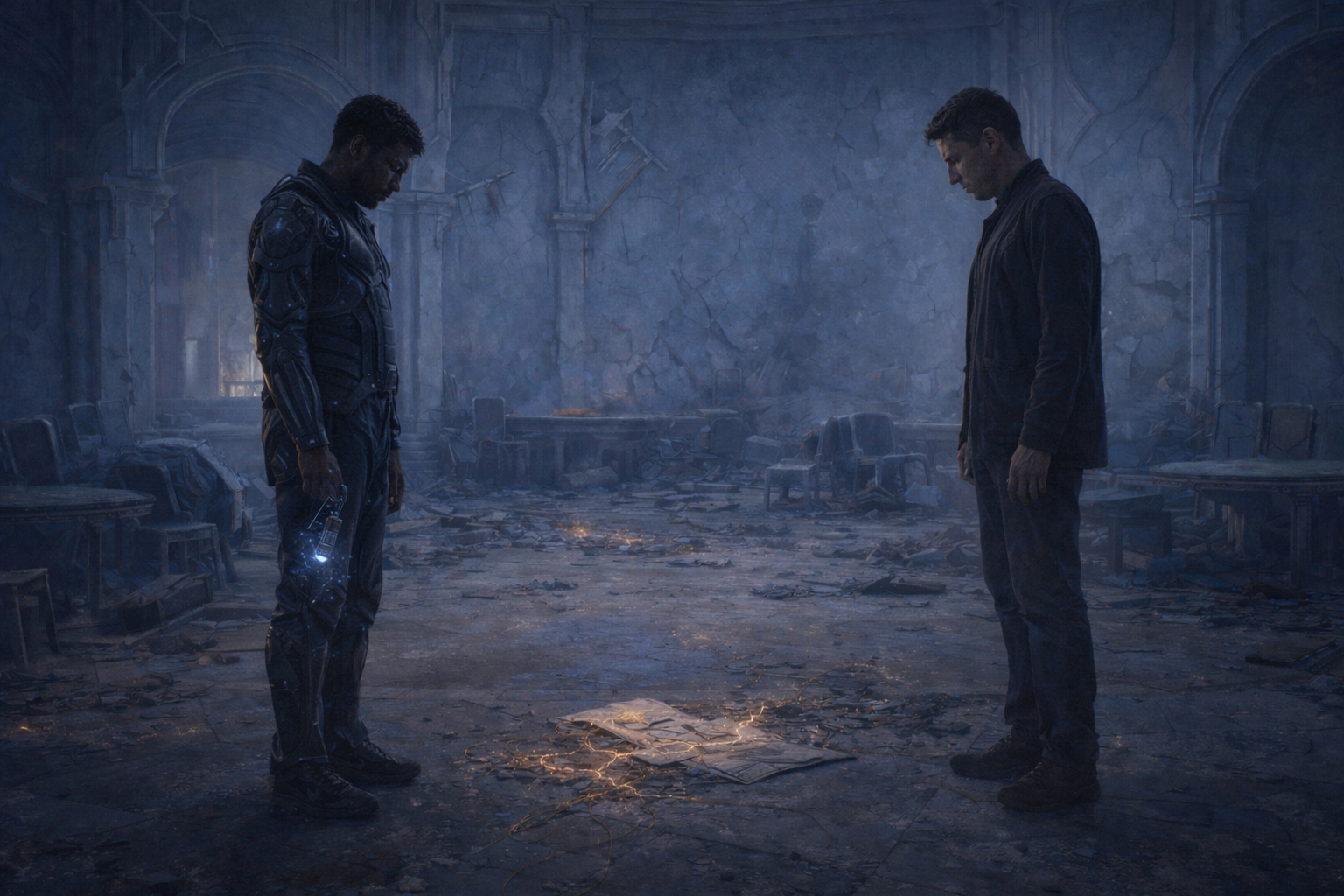
Wesley could feel Kore where he’d left her, patient, steady, the way she’d been through all of this. He didn’t go back to her. He followed Jake’s temporal signature instead — the same signature he’d been tracking since the spree, the one he knew better than any other in the timeline. Jake’s failing technology had dumped him somewhere after the Temple, and the trail was easy to follow because Jake wasn’t trying to hide anymore.
Wesley found him in the wreckage of a moment. Not a dead spot — something worse. A moment Jake had tried to fix and broken instead, an Andorian trade negotiation from the mid-24th century where two factions had been on the verge of an agreement that would have reshaped their economy for generations. Jake had reached in and pushed, tried to guarantee the outcome he’d calculated would produce the least suffering, and the negotiation had shattered under the imposed certainty. The agreement the factions reached felt hollow to both sides and collapsed within months. Within a year they were at war.
Jake was standing in the aftermath, watching the thing he’d tried to save burn. His temporal technology was damaged from the Temple — the device that had forced him through Sisko’s door was barely functional, flickering at the edges the way Jake himself had been flickering since the Prophets pulled him out. He looked smaller than Wesley expected. Not the shadowy presence that had haunted the timeline for years, not the faceless manipulator behind the Suliban. Just a man in his thirties standing in a place where his best intentions had produced the worst possible outcome. Wesley appeared behind him and waited for Jake to notice.
Jake didn’t turn around immediately. He stood still the way someone stands when they know they’re being watched and are deciding how to handle it. When he finally turned, his expression wasn’t what Wesley expected — not surprise or hostility or the cold calculation of a temporal strategist confronting his opponent.
He looked tired. The kind of tired that goes deeper than exhaustion and settles into the architecture of a person’s face. His voice still carried the damage from the Temple, raw and rough, and when he spoke it was without any of the commanding presence that Future Guy’s distorted communications had always projected.
He told Wesley he’d been expecting this. That after the Temple, after his father, after everything — of course Wesley would come find him. The man who’d been countering his work across the timeline finally had a face and a name and a father who made good gumbo, and now Wesley wanted to talk. There was something bitter in how he said it, but the bitterness was pointed at himself rather than at Wesley.
They stood in the ruins of the Andorian moment together, two people surveying damage they’d collectively contributed to, and for the first time neither of them was trying to undo what the other had done.
Wesley told Jake he hadn’t come to fight. That he’d learned some things since the Kelvin that changed what he thought he knew about his own work, and he wasn’t sure the two of them were as different as Wesley had believed. Jake went quiet at that. It wasn’t what he’d expected to hear from the person who’d been opposing him.
Wesley told him the short version — the spree, Kore leaving, the Entity shattering his perception, D’Kar’s math, the Guardian’s map, Q dying in a bar, his father’s gumbo going cold on a table in a place that didn’t exist. Jake listened the way someone listens when the person talking is describing a version of their own life from a different angle.
Jake told Wesley about the Dominion War. Not the strategic overview — the numbers. Eight hundred million dead. Cardassian children starving in the aftermath. Whole civilizations ground down to nothing by a conflict that most of the galaxy’s population couldn’t have pointed to on a map before it started. He told Wesley about sitting in his quarters on DS9 as a teenager, reading casualty reports that arrived faster than his father could process them, watching the man he admired most in the universe carry the weight of decisions that sent people to die by the thousands.
And then the man who carried all of that weight was taken away by beings who existed outside of time and didn’t experience loss the way linear beings did, and Jake was left in a world that had just finished bleeding from a war his father helped fight, without a father to help him understand any of it.
He asked Wesley what he was supposed to do with that. With the capability to reach into time and the knowledge that eight hundred million people had died in a conflict that a single well-placed intervention could have prevented or shortened or redirected. With a father who chose the Prophets over staying, who chose to exist outside of time while his son lived inside it, carrying the grief alone.
Wesley told Jake that he understood. That he could see what had driven Jake to do what he’d done, and that it made sense in a way that was harder to argue with than anything Wesley had expected when he was fighting a faceless shadow across the centuries. Jake’s expression shifted at that — something cracking underneath the exhaustion. He told Wesley that understanding wasn’t the problem. Understanding was the easy part. The problem was what it produced.
Wesley asked Jake what he meant. Jake told Wesley to look around. At the Andorian negotiation he’d tried to fix. At the agreement that shattered, the war that followed, the lives that were worse because Jake had tried to make them better. And this wasn’t the worst example — this was just the one he happened to be standing in when Wesley showed up.
He told Wesley he’d known for years that something was wrong with his work. The moments he fixed didn’t hold, the outcomes felt brittle, the universe kept rejecting the certainty he tried to impose on it. So he’d pushed harder and the wrongness got worse, and he’d pushed harder still because the only alternative was admitting that the thing he’d built his identity around was the thing causing the damage.
Wesley’s hands went cold. He was listening to someone describe his own condition — the compulsion, the inability to stop, the identity so wrapped around the mission that removing the mission meant removing the person. Jake was saying it about himself but it applied to Wesley with the same precision, and standing in the wreckage of Jake’s work while hearing his own reflection described back to him was the kind of recognition that doesn’t leave room for denial.
Jake asked Wesley what the solution was. Wesley told him he didn’t have one yet. That D’Kar’s math was still running with the Guardian’s scope data, that the picture was incomplete, that he was following threads and talking to people and trying to understand the problem well enough to see the answer inside it.
Jake told Wesley that whatever the solution turned out to be, it wasn’t going to be cheap. He said it quietly, not as a threat or a warning but as someone who’d spent enough time inside the problem to know that structural problems demand structural costs. The closer you are to the center of the problem, the more it takes from you to fix it.
Wesley heard that without fully absorbing it. It sounded like philosophy, like the kind of thing people say when they don’t have specifics. He didn’t yet understand how literal Jake was being.
Jake told Wesley he’d started to suspect something about his own role in the equation — that the math might look better without him in it. He hadn’t followed that thought all the way to its conclusion. Couldn’t bring himself to, because following it meant accepting that the thing he’d built his life around was the thing that needed to be removed.
Wesley heard that and thought about the Kelvin. About D’Kar’s 1.6 per intervention. About the Guardian’s map showing his work on the same feeding lines as Jake’s.
Jake looked at Wesley, and stripped of the temporal masking and the fury and the certainty, he looked like what he was — a man in his thirties who had lost his father and spent his entire adult life trying to make sure no one else ever had to feel what he felt. He told Wesley that the cost always lands on the people still living in linear time, that the agents come and go and the manipulators push and pull but the people in the moment carry everything.
Wesley thought about his mother. About the photograph on her desk. About her voice saying his name to an empty sickbay. He thought about everyone he’d met on this journey — the ones who’d stopped, the ones who’d stayed, the ones who’d never paid for anything and were dying of the debt. Every one of them had someone, an anchor, a reason that existed in the present tense rather than in the mission. Wesley didn’t have anyone right in front of him. He hadn’t for thirty years. That was the cost he’d already paid without noticing.
Jake saw it on Wesley’s face — the recognition of a loneliness so familiar it had become invisible. And Jake did something Wesley didn’t expect from the person he’d spent months fighting across the timeline. He sat down in the wreckage of the Andorian moment and told Wesley to sit with him, and for a while neither of them said anything. Two people who’d been destroying the timeline from opposite directions, sitting in the ruins of one of those destructions, keeping each other company because there was nobody else in the universe who understood what they were carrying.