Chapter Seven: The Emissary
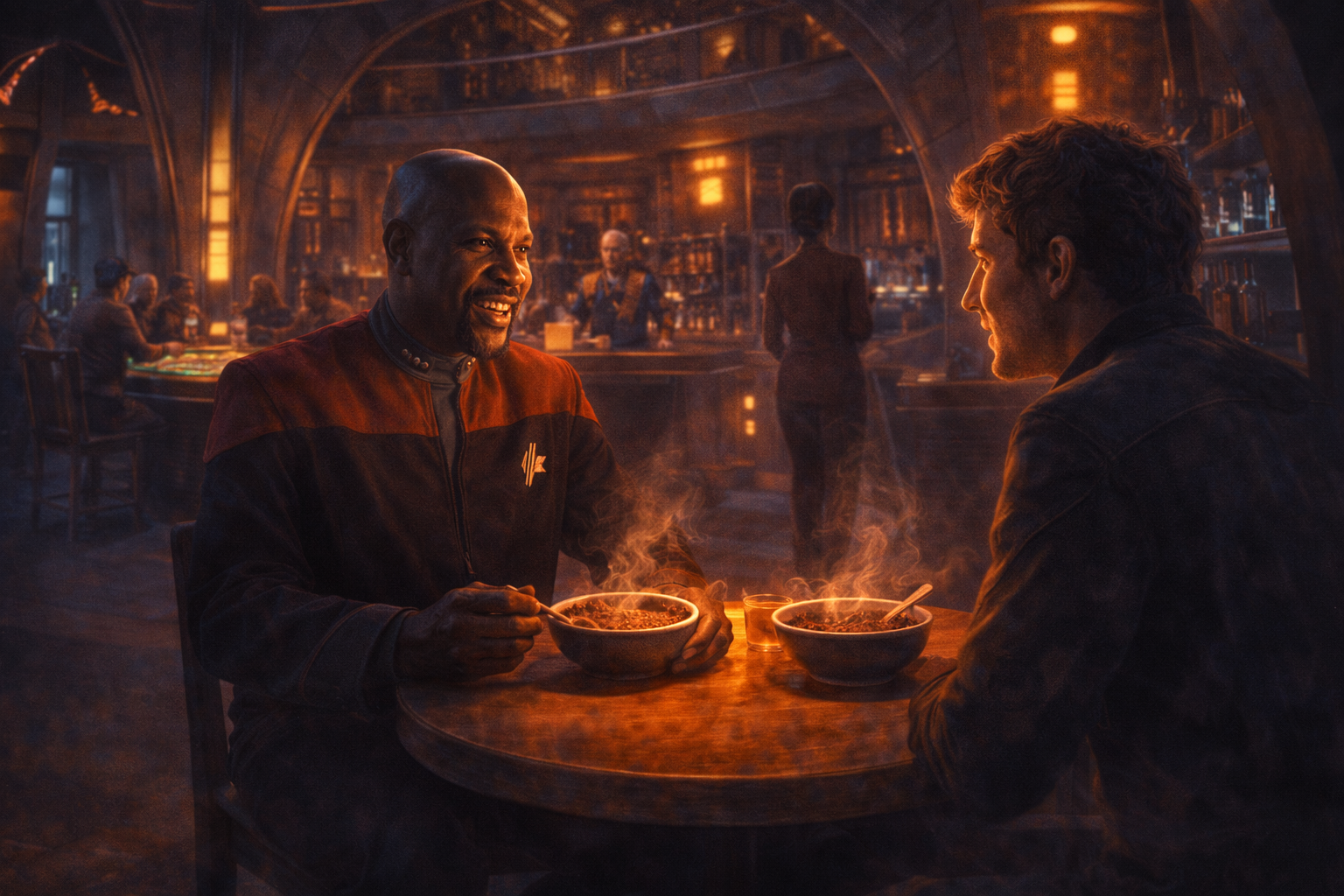
The gumbo was still in front of him. Wesley stared at the bowl — the same bowl Joseph had brought him, the same recipe, still warm. But the restaurant was gone and the man sitting across from him wasn’t Joseph anymore and the sounds of a New Orleans evening had been replaced by the ambient noise of a Bajoran space station’s social hub on what seemed like a perfectly ordinary night.
Quark’s. He’d never been here but he’d heard about it his entire career — the bar on Deep Space Nine where Starfleet officers and Bajoran merchants and Ferengi bartenders occupied the same room and somehow made it work. The Dabo table was still spinning behind him, patrons were still pushing latinum across felt, and the whole place was alive with the particular energy of a community that had survived a war and a occupation and a wormhole to alien gods and come out the other side still willing to sit down and have a drink together.
Benjamin Sisko was eating gumbo with the unhurried pleasure of a man who understood that a good meal was not a thing you rushed through on your way to something more important. He looked up at Wesley and something in him lit up — not a smile exactly, though it became one. Something deeper, a warmth that started behind his eyes and radiated outward until the whole man seemed to glow with it, the way certain people glow when they’re exactly where they’re supposed to be doing exactly what they were made to do. He told Wesley he was glad he’d enjoyed his father’s cooking.
Wesley asked about the disguise. Why Joseph first. Sisko told him it wasn’t a disguise. It was a choice. He said he’d known Wesley was coming since the Guardian pointed him this way, and he’d known Wesley wasn’t ready. A man who’d just watched Q coming apart in a bar and had his own compulsion named by a centuries-old El-Aurian wasn’t in a state to hear what Sisko needed to tell him. He needed to eat first, needed to sit across from someone who didn’t want anything from him except to see him fed, needed to be inside a moment — a real one, with real food and real warmth — before the conversation turned to things that would make him want to step outside of moments forever.
His father was better at that part than Benjamin was. Joseph Sisko could make anyone feel like they belonged at his table, and that was a skill that had nothing to do with the Prophets or the Emissary or non-linear time. That was just a man who’d spent his life feeding people because he believed that was the most important thing a person could do.
Sisko told Wesley he’d needed to remember what that felt like — being taken care of without an agenda — before they talked about what it cost to take care of someone and not be able to do anything for them.
Then he spooned more gumbo and told Wesley his father’s recipe was better than his own and he’d never admitted that to anyone. Joseph’s secret was patience — he let the roux go longer than Benjamin ever had the nerve to, trusted the process when it looked like it was about to burn, and somehow it never did. Benjamin said he’d spent his whole life trying to learn that kind of patience and his father had been born with it.
For a while they just ate. Sisko asked Wesley about the Enterprise, about Beverly, about whether Picard had ever lightened up or if he was still walking around like a man who’d accidentally been given command of someone else’s ship. Wesley told him Picard had always been exactly who he was, and Sisko laughed — a full laugh, the kind that belonged in this bar, that bounced off the walls and made a Bajoran waitress look over and smile because laughter at Quark’s was a sound the station had earned the hard way.
Sisko talked about building the house on Bajor. About the soil there, how different it was from Louisiana clay, how he’d had to learn everything from scratch because Bajoran earth didn’t respond to the same techniques. He talked about Kasidy and the baby he’d left behind when the Prophets took him and how the hardest part of non-linear existence wasn’t seeing all of time simultaneously — it was knowing that his wife and child were living their lives in real time and he was experiencing those lives the way you experience a book you’ve already read.
He talked about Jake as a boy. How Jake had wanted to be a writer since before he could properly hold a stylus, how he used to sit in their quarters on DS9 and work on stories for hours because he believed that if he could find the right words for what he saw, he could make other people see it too. Jake at fifteen was one of the most earnest people Benjamin Sisko had ever known — not naive, but earnest. He understood that the world was hard and he believed it was worth describing honestly. Writing was the way Jake made sense of things, the way he processed a universe that didn’t always make sense on its own.
Wesley listened to a father describe his son and felt the weight of it settle into the gumbo in front of him — something warm becoming something heavier with every sentence.
Sisko told Wesley what happened. He didn’t start with the strategy or the scope of what his son had done. He told it the way a father tells it — starting with the loss. The Fire Caves. Dukat and the Pah-wraiths. The final confrontation that Sisko won by throwing himself and Dukat into the fire together. The Prophets taking him at that moment — not a choice, not a negotiation. A consequence. He defeated the enemy and the reward was being removed from the life he’d built. He told Kasidy he’d be back. He didn’t know when.
Jake lost his father to something he couldn’t fight or negotiate with or understand. Not death — that would have been comprehensible, grievable, something with a shape he could hold. This was worse. His father was somewhere, alive in some sense, but unreachable and untouchable and gone in a way that had no resolution because it had no ending. Jake — the boy who believed the right words could make people see — tried to find the right words for what had been done to him. And couldn’t.
Mid-sentence, the bar was gone. Wesley was standing on the upper level of the Promenade looking down at the life of the station — merchants selling goods, officers off-duty, a group of Bajoran children chasing each other through the crowd. Sisko was beside him, still holding his gumbo, spooning it like the location change was the most natural thing in the world. The whole messy beautiful life of a community that Sisko had spent years building from the wreckage of a Cardassian mining station was happening below them, and Sisko watched it the way a man watches something he built with his hands.
Wesley sensed the weight of this place the way a Traveler senses moments. The wind moved through it — the leaves were alive here, connected, carrying consequence the way healthy moments should, each one connected to the ones around it, propagating forward, mattering. Sisko had built that by being present in one place for years and caring about the people in it.
Sisko spooned his gumbo and kept talking about Jake, and the warmth in his voice started to carry something heavier. Jake had always dug into things — underneath the surface, into the why of how things worked. That’s what made him a writer. After Sisko left, that same instinct turned toward temporal mechanics, because that’s where his father had gone. He started studying time to understand the thing that took his dad.
But Jake was brilliant, and that was the tragedy. His father’s son — stubborn, capable, the kind of person who holds a course through impossible conditions. The studying became research, the research became experimentation, and somewhere along the way Jake crossed the line between understanding time and manipulating it. Each step was small enough to justify, and by the time the line was behind him he couldn’t see it anymore.
Once he could manipulate time, he decided he should. Because no one else should have to feel what he felt. Because suffering that could be prevented was suffering that should be prevented. Jake had the tools and the pain and the conviction, and that combination only produces one outcome.
Sisko stopped and looked at Wesley across the cooling gumbo. He told Wesley that the presence he’d been fighting across the timeline, the shadow behind the Suliban, the one Wesley had been calling Future Guy — that was Jake. His son. The boy who wrote stories about the world as he found it had become the man who was trying to rewrite all of them.
Sisko watched Wesley absorb that. Watched the enemy become a person in Wesley’s mind, watched thirty years of fighting a faceless shadow collapse into a father sitting across a table telling you about his kid over dinner. Then Sisko told Wesley he’d watched every step of it from inside the Celestial Temple.
They stopped at the viewport. The wormhole was visible from here — or the place where the wormhole would open, a patch of space that looked ordinary but contained the doorway to the Prophets, to non-linear time, to the place where Benjamin Sisko existed now. Wesley looked at it and understood that he was looking at the thing that had taken a father from his son and a son from his father, and that the man standing next to him holding a bowl of gumbo had been on the other side of that doorway watching the consequences unfold for years.
Sisko stopped eating. It happened quietly — the spoon settling against the side of the bowl, his hand going still, the rhythm of eating that had carried him through the conversation finally stopping. Wesley noticed because the absence of that rhythm changed the quality of the silence between them the way a heart skipping a beat changes the quality of a body’s stillness.
Sisko told Wesley he could see all of Jake’s paths. Every version, every choice, every branching possibility from every decision Jake had ever made or would ever make. He could see the paths where Jake found peace and the paths where Jake destroyed himself and the paths where Jake’s manipulations helped people and the paths where they devoured everything. He saw all of it simultaneously, without the mercy of sequence. And he chose not to stop any of it.
Wesley asked why. Sisko looked at him across the bowl of cooling gumbo with an expression that had nothing to do with wisdom or philosophy or the cosmic perspective of a man who existed in all moments at once. It was the expression of a father who was watching his child walk toward a cliff and had decided that the cliff was Jake’s to walk toward or turn away from. He told Wesley that knowing what someone will choose doesn’t mean you should take that choice away.
Wesley pushed back. Hard. He told Sisko that was easy to say from inside the Celestial Temple. That it sounded like wisdom but felt like abdication. That Jake was out there right now manipulating moments, feeding the Entity, creating dead spots where meaning used to be. People were losing the capacity to care about their own choices because of what Jake was doing, and Sisko could see all of it and was choosing to let it happen.
Wesley’s voice was louder than he intended, and he kept going before Sisko could respond. He told Sisko that choice didn’t matter if it destroyed everything, that freedom was meaningless in a dead spot where people could choose all they wanted and none of it carried forward. Jake’s freedom to manipulate was eating everyone else’s freedom. At some point restraint stopped being love and became negligence, and at some point a father who could stop his son and didn’t wasn’t respecting Jake’s choices — he was hiding behind them. The Dabo wheel spun somewhere behind them and someone cheered and the sound landed in the silence between Wesley and Sisko like a coin dropped in an empty room.
Sisko didn’t get angry. He leaned forward and asked Wesley a question. He asked Wesley what it had cost the timeline for Wesley to counter Jake’s manipulations. What it had cost the moments he’d reached into. What it had cost the people inside those moments who never knew he was there.
Wesley couldn’t answer, because the answer was the Entity, the answer was the dead spots, the answer was everything he’d been learning since the Kelvin.
Sisko told him that was the difference between what Wesley had done and what Sisko was doing. Wesley acted, and the cost landed on everyone but him. Sisko stayed, and the cost landed on no one but himself.
Sisko picked up the gumbo again. Not because the hard part was over — because he was choosing to stay inside the moment even when the moment was unbearable. That was the lesson, Wesley realized, and Sisko wasn’t teaching it with words. He was teaching it by eating.
Sisko asked Wesley the question. The one Wesley had known was coming since the Guardian’s data module had pointed him here. What are you willing to lose?
Wesley didn’t answer. Not because he didn’t know, but because the answer was too heavy to say out loud in a place where all moments existed simultaneously and the weight of a spoken word never dissipated.
He looked at Sisko — at this man who had given up everything and stayed, who had watched his son become the thing Wesley had been fighting, who had carried the cost of restraint in his own body without passing it to anyone else. A man who could sit at a viewport overlooking the doorway that had stolen his life and eat gumbo because eating gumbo was how he stayed human.
And Wesley understood, for the first time, what it might actually require to stop feeding the Entity. Not just stopping, not just stepping back. Staying inside the cost without moving, without fixing, without reaching. Being present in the damage the way Sisko was present in Jake’s choices, and carrying it without passing it on.
Sisko told him there was nothing to thank him for. Then he told Wesley that the question wasn’t how to fix the Entity or how to stop Jake or how to reverse the damage. The question was whether Wesley could live inside the cost of the answer without reaching in to make it hurt less — for himself or for anyone else. Because the answer, whatever it turned out to be, was going to cost something that couldn’t be fixed afterward, and Wesley would have to carry that without passing it to someone else the way he’d been passing the cost of his interventions to the timeline.
Then Sisko’s expression changed. The warmth was still there but something moved underneath it — a tightening, a shift in the way he held himself, like a man who hears a car pulling into the driveway and knows who’s in it before the door opens. He set the gumbo down and looked toward the far end of the Promenade as if he could see through the walls of the illusion to whatever was approaching from outside. He told Wesley it was time to go.
Wesley asked what was happening. Sisko told him the door he’d opened to let Wesley into the Temple — the threshold at Joseph’s restaurant, the crack in the Celestial Temple’s walls that the Prophets normally kept sealed — that door hadn’t fully closed behind Wesley. And someone who’d been trying to get through for years had just felt it open.
Sisko’s face was calm. Not peaceful — calm in the way a man is calm when he’s already decided how he’s going to handle what’s coming and the deciding was the hard part. He told Wesley to leave, and the way he said it wasn’t a suggestion.
The illusion dissolved. The Promenade faded, the viewport dimmed, the sounds of the station went silent one by one. The gumbo went last. And Wesley was standing outside Joseph’s restaurant in New Orleans, on a sidewalk, in linear time, with Kore waiting for him across the street. She looked at him and knew something had changed.
He looked back at her, and before he could explain, he felt it — a violent disturbance in the direction of the Celestial Temple. Temporal technology tearing at the crack Sisko had opened for him, forcing it wider. Someone hammering through a door that had been closed to them for years and was suddenly, briefly, not fully sealed.
Wesley recognized the signature. He’d been fighting it since the Kelvin. The shadow behind the Suliban, the presence across all of Trek history, the one he’d been calling Future Guy. Jake. Sisko’s son. The boy who wrote stories, forcing his way into his father’s prison with technology that was destroying him just to use it.
And Sisko had known this would happen. Had opened the door for Wesley knowing it would give Jake the crack he’d been looking for. Had fed Wesley gumbo and told him about his son and timed every moment of it so that Wesley would be standing right here, right now, close enough to feel Jake arrive and close enough to go back and witness what came next. Wesley understood. Sisko’s final lesson wasn’t in the conversation. It was in what was about to happen — and Sisko needed Wesley to see it.
He told Kore to wait. Then he went back.