Chapter Eight: Jake
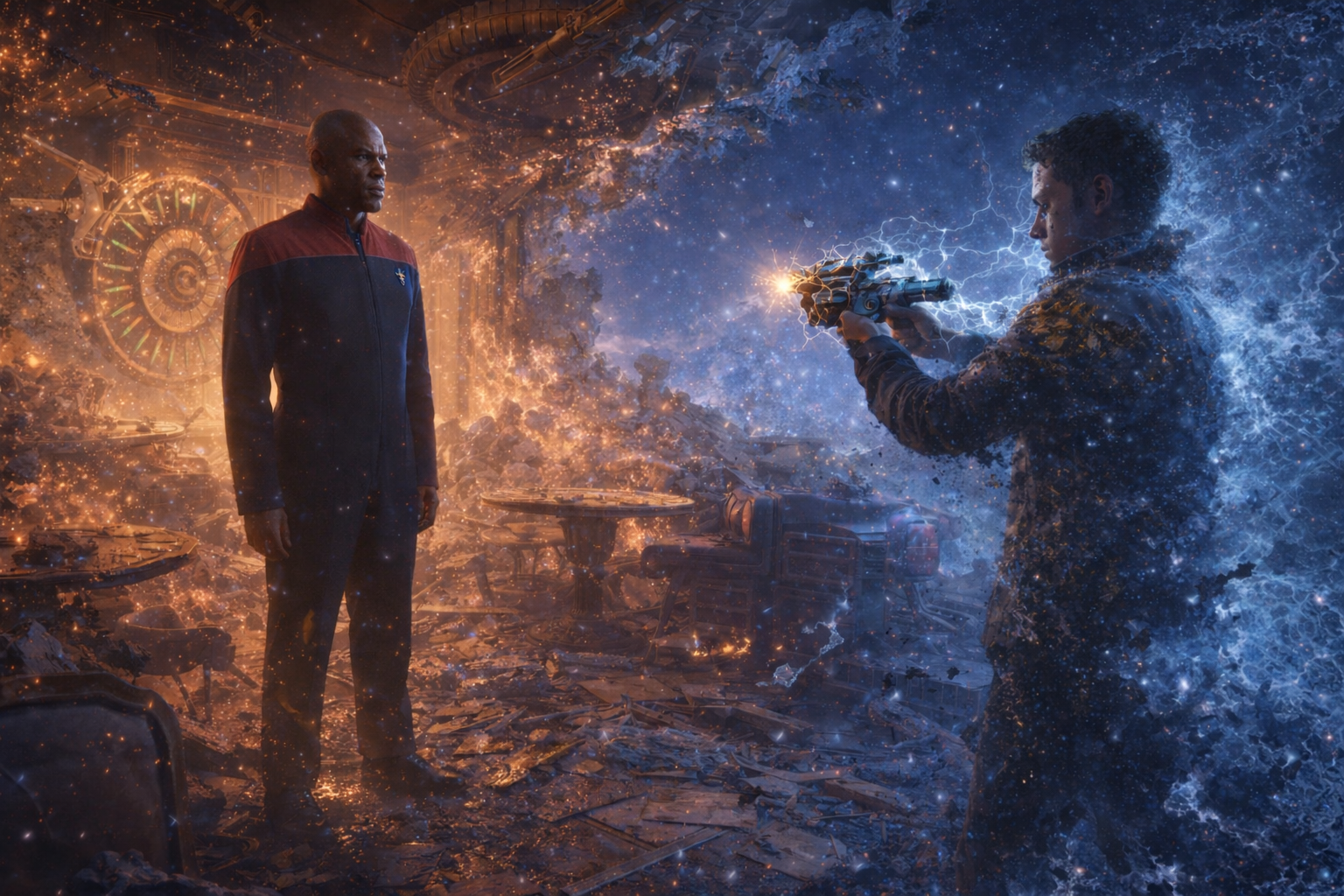
Wesley went back through the crack. The threshold at Joseph’s restaurant was still open — barely, and closing — and Wesley slipped through it the way a Traveler slips between moments, fitting himself into a gap that was already narrowing. Behind him, the New Orleans street disappeared. Ahead, the Celestial Temple reassembled itself around him, but wrong. The Quark’s illusion that Sisko had built was fracturing, tables phasing through each other, the phantom lighting stuttering between warm and cold. Someone was forcing their way in from outside and the Temple was fighting to maintain its structure against the intrusion.
Wesley found a place to watch from outside the moment. Not inside the illusion, not part of what was about to happen. Adjacent. The way Travelers exist adjacent to moments they’re attending — present but not participating, close enough to see and feel everything, unable to be seen.
He didn’t intervene. After everything Sisko had just told him, after the gumbo and the Promenade and the viewport and the question he couldn’t answer, the idea of reaching into this moment felt like reaching into someone else’s surgery. This wasn’t his. This belonged to Sisko and to the person forcing their way through the crack.
Jake materialized in the wreckage of Quark’s. Not cleanly — the temporal technology he was using screamed against the non-linear space the way metal screams against stone. He phased in and out, his form flickering between states, the device he carried burning through power at a rate that couldn’t be sustained. Whatever he’d built to get himself in here was destroying itself to maintain his presence, and it was hurting him. Wesley could see the damage accumulating in Jake’s temporal signature with each second of sustained presence — the kind of damage that doesn’t regenerate.
He was concealed. Masked by the same temporal distortion Wesley had been tracking across centuries — the shadowy, shifting presentation that made Future Guy impossible to identify. From a distance, through the distortion, you’d see what Wesley had always seen: a figure without a clear face, a presence that operated through intermediaries, an enemy defined by what he did rather than who he was. But Wesley wasn’t at a distance anymore. And he already knew who was behind the mask because a father had told him over gumbo an hour ago.
Sisko stood in the middle of what was left of the illusion. The illusion of Quark’s was breaking apart around him — walls dissolving, the Dabo table frozen mid-spin, phantom patrons flickering out of existence as the Temple’s processing power redirected to managing the intrusion. The warm, lived-in space that the Prophets had built so Sisko could remember what it felt like to be human was crumbling, and Sisko stood in the wreckage of it the way he stood in everything — present, upright, and not reaching for anything to hold onto.
He looked at the figure materializing in front of him and his expression carried nothing Wesley had seen on any version of Benjamin Sisko in any moment he’d ever attended. Not surprise, not anger, not the command face of a Starfleet captain assessing a tactical situation. Pain. The specific pain of a man who had watched this moment approaching across every possible timeline and had chosen not to prevent it. Sisko said one word. Jake.
The concealment didn’t drop immediately. It faltered — the outermost layers of masking failing first, the temporal distortion peeling back in stages as the technology burned itself out. Through the gaps Wesley could see fragments of the person inside — a jawline, the set of shoulders, hands gripping a device so tightly the knuckles had gone white. Young. Early thirties. The age Jake would have been when the obsession took hold and the capability caught up with the grief.
Jake was holding a weapon — something Wesley had never seen before, improvised from pieces of temporal mechanics that were never meant to be combined into a single device. It looked unstable. It looked like it was hurting him to hold it. He pointed it at his father.
And Wesley, watching from outside the moment, finally understood something that all the data and all the math and all the conversations hadn’t been able to teach him. Future Guy — the shadow he’d been fighting, the presence he’d been tracking, the enemy he’d built his post-Kelvin identity around opposing — was a kid pointing a weapon at his dad in a broken bar because he didn’t know what else to do with thirty years of missing him.
Jake couldn’t fire. Wesley could see it in the temporal signature of the moment — branching possibilities collapsing and expanding and collapsing again as Jake’s finger tightened and loosened on the device. A thousand timelines where he pulled the trigger, a thousand where he didn’t. The moment oscillating between them so fast it created its own interference pattern.
His hand shook. The weapon’s instability amplified the tremor, temporal feedback turning a human tremor into something that distorted the space around his arm. The technology was burning him visibly now, his form losing definition at the edges the way a signal loses clarity when the source is failing.
And still he couldn’t fire, because the man standing in front of him wasn’t Future Guy’s enemy or the Prophets’ instrument or the Emissary of Bajor. He was Jake’s father, and some part of Jake — buried under years of grief and obsession and the absolute certainty that he was right — still knew that. The weapon dropped. Jake’s arm fell to his side. The device clattered against the floor of the broken illusion.
And then Jake broke. Not cleanly. Not the way people break in stories where the breaking leads somewhere meaningful. This was ugly and graceless. Jake’s grief expressed itself as fury because fury was the only container he had left for something that had been building since the day the Prophets took his father.
He came at Sisko with his hands. No weapon, no technology, no temporal manipulation. Just a son hitting his father because he didn’t know how else to say what he needed to say. Open-handed, closed fist, it didn’t matter — the violence was formless, the physical expression of a man trying to beat an answer out of someone who refused to give one. He grabbed Sisko’s shoulders and shook him and pushed him and hit him again.
Sisko didn’t fight back. Didn’t block, didn’t dodge, didn’t use whatever power the Prophets had given him to deflect or absorb or redirect. He stood inside his son’s rage the way he’d been standing inside his son’s choices for years — present, receiving, carrying the cost in his own body without passing it on.
Wesley watched from outside the moment and felt his hands ball into fists. Every instinct he’d built over a lifetime — every Traveler reflex, every compulsion to reach in and fix and widen and restore — screamed at him to do something. Collapse the weapon’s temporal field, stabilize Jake’s signature, widen the possibility space so this moment could play out without violence.
He didn’t move. Because of Sisko’s face. The face of a man who had just taught Wesley about restraint by eating gumbo, and was now demonstrating what restraint actually cost when it wasn’t a philosophy lesson in a phantom bar but a father choosing to let his son hit him rather than take away his right to be angry.
Sisko tried to speak. Between the blows, while Jake’s fury burned through its fuel, Sisko tried to tell his son what he could see from non-linear time. That what Jake had built — the controlled timeline, the softened Federation, the universe where suffering was prevented by eliminating the possibility of it — wasn’t safety. That the moments Jake had manipulated still existed but they didn’t carry weight anymore. That preventing pain and preventing meaning were the same thing, and Jake’s solution was producing a universe where losing a father wouldn’t even hurt because nothing hurt in a dead spot.
Jake couldn’t hear it. Wesley watched the words land on Jake the way his own interventions landed on dead spots — technically delivered, carrying nothing. The rage was too loud, the grief too structural. You can’t hear truth from the person you’re beating. The fists aren’t just hitting — they’re drowning out everything the target is saying, because hearing it would mean the hitting has to stop, and stopping would mean sitting with the pain that started the hitting in the first place. Sisko’s words landed on nothing, and he took the next blow knowing they hadn’t.
Jake’s fury burned itself out the way fires burn out — not because someone extinguished it but because it ran out of fuel. The punches slowed, the grip loosened, Jake’s legs gave way and he sank to the floor of the shattered bar, hands still reaching for his father’s jacket, holding on because letting go would mean admitting that this hadn’t changed anything.
Sisko went down with him. Not to comfort, not to hold. Just to be at the same level. Eye to eye. Father and son on the floor of a broken illusion surrounded by the debris of a place that had been built to help Sisko remember what it felt like to be human.
Jake spoke. His voice was wrecked — raw from the effort, from the temporal burns, from the weight of what he was about to say out loud for the first time. He told Sisko he knew about the spreading corruption, the places where choice was dying, the thing consuming reality. He told his father he’d been trying to cauterize it by eliminating all uncertainty, removing the possibility of bad outcomes before they could occur. Controlling the timeline so tightly that nothing could go wrong in it again. Better a controlled universe than chaos. Better certainty than entropy.
Wesley heard Jake’s reasoning and felt something shift inside him that went beyond understanding. He tried to hold onto the distinction — Jake controls, Wesley restores. Jake narrows, Wesley widens. They are not the same — and felt himself gripping it the way Jake had gripped the weapon, tightly, desperately, because letting go meant admitting something he wasn’t ready to admit. Different wounds, same response — reach into time and make it stop hurting. Wesley let go of the distinction. It didn’t fit anymore and holding it was costing him something he couldn’t afford. And it had been costing him long before this. The distinction had been the permission. As long as he believed he wasn’t the same as Jake, he could do what Jake did and call it something else.
On the floor of the broken illusion, Jake’s temporal technology was giving out. The device he’d used to force his way into the Temple was failing, its energy spent, and Jake’s presence was starting to flicker the way it had when he first materialized — except now the flickering was pulling him out instead of holding him in.
Jake looked up at his father. Their eyes met. Sisko’s face carried everything he couldn’t say and Jake’s face carried everything he couldn’t hear, and for one moment they were just a father and son sitting on the floor of a broken room with nothing between them but the distance that neither of them knew how to close.
Jake’s head dropped. A tear hit the floor of the illusion — a real tear, from a real person, landing in a place that wasn’t real and making a sound anyway. Then the temporal field caught him and pulled him out and he was gone.
The Prophets spoke. The Prophets’ voice filled the fractured space the way water fills a cracked vessel — finding every gap, every break, every place where the illusion had shattered and reality showed through. They spoke to Sisko, not to Wesley, and what they said was short and cryptic and delivered in the non-linear way the Prophets always communicated — meaning arriving before sequence.
They told Sisko that his son’s path was not finished. That the one who had witnessed this — and Wesley felt their awareness brush against him like wind through an open door — carried what Jake needed to see. They didn’t explain what that meant or when it would happen or how. They confirmed one thing only. Sisko’s choice to not fight back was correct, and it would matter.
Sisko sat alone in the wreckage of Quark’s bar. The illusion slowly rebuilt itself around him — tables reassembling, lights stabilizing, the phantom sounds of a normal evening returning one by one, filling the silence Jake had left behind. Bruises forming on a face that hadn’t defended itself, damage that would heal on a body that existed in non-linear time, where healing meant something different than it did for people who lived in sequence.
Wesley watched from outside the moment — watched a father who had just taken a beating from his own son without raising a hand sit back down at his table and pick up a bowl of gumbo that had gone cold.
Sisko looked at the gumbo for a long time. Then he started eating again. Cold. Because eating was how he stayed inside the moment, and this was a moment he was choosing not to leave.
Wesley left the Temple for the second time. The crack closed behind him. This time it sealed completely. He was back on the sidewalk in New Orleans. The evening air hit him and he stood there for a long time, not moving, not speaking, trying to hold everything he’d just witnessed in a body that wasn’t designed to carry that much weight at once. Kore was across the street. She could see his face and she didn’t ask what happened.