Chapter Six: Guinan and Q
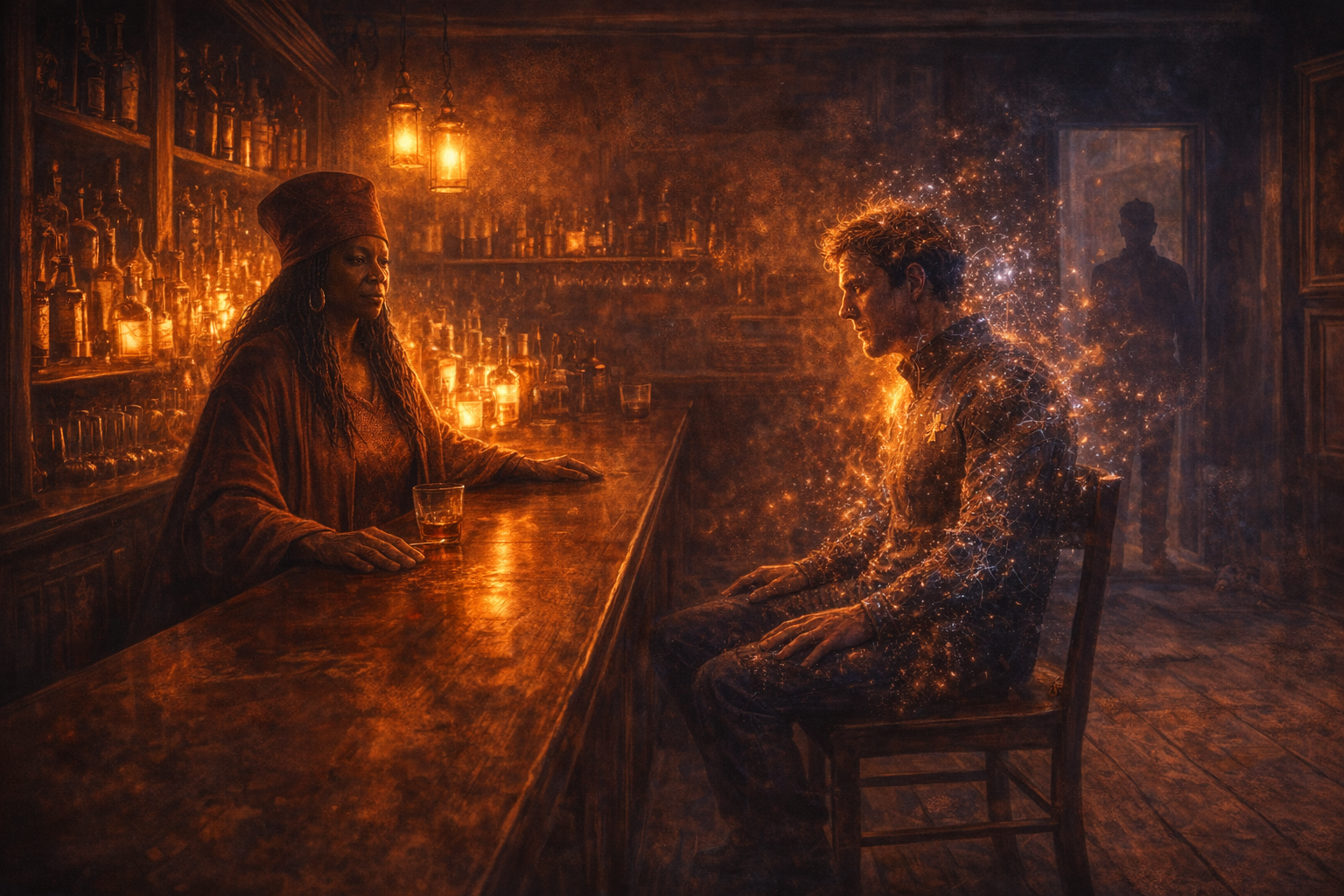
They both felt it leaving the Guardian’s planet, a pull that had nothing to do with temporal mechanics. A direction, not forward through the timeline but backward through Wesley himself. Back to who he was before any of this — before the Traveler, before the rule, before thirty years of maintaining a timeline that was being eaten from the inside.
Wesley needed to find someone who remembered that person. Kore knew it too. They looked at each other and said the name at the same time. Guinan.
Wesley hadn’t thought about her in decades but the moment her name landed in his mouth it felt obvious. The bartender on the Enterprise who’d served him hot chocolate in Ten Forward when he was a teenager trying to figure out if he belonged on the bridge. The woman who’d been alive for centuries and had a way of hearing what you were really saying underneath the thing you thought you were saying. Kore had crossed paths with Guinan through Picard’s circle back when Wesley recruited her, and she’d recognized immediately that Guinan was something different from the usual people who orbited Starfleet captains. They went to New Orleans.
The bar was small, tucked into a street in the French Quarter that didn’t draw attention. Wesley and Kore walked in expecting to find Guinan polishing glasses behind the counter. They found her in the middle of an argument. Kore stayed near the door — this looked like something for Wesley alone.
Guinan was standing at the far end of the bar, leaning forward with the particular intensity she reserved for beings she’d known long enough to stop being polite with. Across from her, sitting in a chair that seemed barely able to contain what was happening to him, was Q.
Wesley had never met Q directly but he’d grown up on a ship Q had visited multiple times. He knew what Q was supposed to look like — the arrogance, the theatrical confidence, the sense that reality was a toy he was choosing to play with. His mother and Picard and the entire senior staff had described that presence often enough that Wesley thought he knew what to expect. What he saw was something else entirely.
Q was coming apart. Not metaphorically, not philosophically — physically. His presence was destabilizing in ways that Wesley’s damaged temporal perception could read like a diagnostic. The vast intelligence was still there but the structure holding it together was failing, shedding coherence the way a star sheds matter when its core can no longer sustain fusion. He was flickering between states — solid, translucent, something that wasn’t either — and each fluctuation was clearly causing him pain in a way that a being who’d never experienced pain before didn’t know how to manage.
And Wesley could see something else, something that made his damaged senses flare with recognition. The patterns on Q’s destabilizing form were familiar. The same signatures Wesley had seen on the Entity in the gap between intervention and result. The same feeding trail he’d learned to identify in dead spots across the timeline. The Entity wasn’t just consuming temporal energy from the timeline. It was consuming whatever the Q Continuum was made of, and Q was wearing the evidence. Guinan and Q both stopped talking when Wesley entered.
The silence lasted long enough for Wesley to understand that the argument he’d interrupted wasn’t casual. Guinan’s expression carried the weight of someone who’d been watching an old adversary die in front of her and couldn’t decide whether to grieve or keep fighting. Q’s expression carried nothing recognizable — he was beyond the emotional vocabulary he’d spent his existence refusing to develop.
Guinan spoke first. She told Wesley she hadn’t known he was coming, which meant something had arranged this that was beyond her ability to sense. She looked at Q and told him the same thing — that his showing up at her bar at the exact moment a Traveler walked in was not the kind of coincidence she believed in.
Q told her he hadn’t come because of Wesley. He’d come because the Continuum was collapsing and Guinan’s bar was where he always ended up when things fell apart, because she was the only person in the universe who would tell him the truth about what was happening to him even if the truth was something he couldn’t survive hearing.
Wesley asked what was happening to the Continuum. Q told him. The Continuum had been aware of something feeding on temporal energy for longer than most civilizations had existed. They’d ignored it the way you ignore a parasite that seems too small to threaten you. But the parasite wasn’t small anymore and the Continuum was discovering that its own existence — the reality-reshaping, the timeline-bending, the casual manipulation of causality that the Q had practiced for eons — had been feeding the thing just as surely as the Temporal Cold War and the Travelers and Future Guy and Wesley himself.
The Q Continuum was dying of the same disease Wesley’s timeline was dying of. Same Entity, same feeding, same cost. The only difference was scale — the Continuum had been generating temporal energy for longer and in greater quantities than any other source in existence, and the Entity had been consuming it patiently, growing in the spaces the Q never thought to check.
Q looked at Wesley and told him that if Wesley found a way to starve the Entity, it might slow or even reverse the Continuum’s decline. He wasn’t asking for help. He was stating a fact — their problems shared a root, and solving one might affect the other. It was the first honest transaction of Q’s existence, a dying god offering what he knew in exchange for the possibility that someone else’s path might lead somewhere useful.
What Q knew was this: power without cost was the most dangerous thing in the universe, not because of what it did to the universe but because of what it did to the one who held it. Q had spent his existence reaching into moments and reshaping them for curiosity, for entertainment, for the sheer experience of being the one who decided what happened next. And it had taught him nothing because there was never a cost. He’d reach in, reshape, withdraw, and Q remained untouched, unchanged, separate.
That separation was the thing that was killing him now. Not just the Entity feeding on the Continuum’s energy, but the deeper realization that he’d spent an eternity interacting with the universe without ever being part of it. Every test he’d imposed on humanity was a question he could have asked himself and never did, and now at the end the only question that mattered was the one he’d spent his existence avoiding.
Wesley pushed back. He told Q he wasn’t the same — Q had reached into moments for entertainment, Wesley had done it to help people, to restore freedom. The intention had to matter.
Q told him the intention was different but the structure was identical. Power applied from outside, without submitting to the conditions inside. Reaching in, reshaping, withdrawing. The moment changed and Wesley remained untouched. That was the part that mattered — not why he reached in, but that he never stayed.
Guinan had been listening to both of them the way she always listened — with the particular stillness of someone who’d been hearing arguments for centuries and could identify the exact moment when both sides were wrong.
She told Q he was close but not right, that there was a difference between what Q had done and what Wesley was doing, and Q was too busy dying to see it clearly. Wesley’s problem wasn’t that he operated from outside. It was that he couldn’t stop reaching in. He’d made intervention his identity, and the moment you can’t stop, you’re no longer choosing.
Q turned to her with the weight of centuries between them — arguments that predated most civilizations, grudges that had outlasted empires. He told her that was easy to say for someone who’d survived by doing nothing, that endurance wasn’t wisdom, that watching the Borg consume her world and rebuilding afterward wasn’t moral superiority but stubbornness dressed as philosophy.
Guinan told him the difference between endurance and stubbornness was that endurance changed you. She’d rebuilt differently every time, lost differently, loved differently. She’d been inside every moment of it, subject to the same conditions as everyone around her. Q had never been inside anything, and by the time he understood what that cost him he didn’t have enough left to change it.
Q didn’t respond to that. He flickered again, harder this time, the destabilization visible across his entire form. For a moment Wesley could see through him to the chair behind, and the feeding patterns on his surface pulsed with the same rhythm Wesley had felt from the Entity in the gap. Q was being consumed in real time. Sitting in a bar in New Orleans, arguing with the only person who’d ever told him the truth, and the Entity was eating him while he talked.
Wesley did something he hadn’t planned. He reached out and steadied Q’s temporal signature the way Kore had steadied his after the Entity encounter. Not healing, not fixing — just holding the coherence together for a few more minutes. Buying Q time with the same Traveler ability that had been feeding the Entity every time Wesley used it on the timeline.
The irony wasn’t lost on him. Using the ability that caused the problem to temporarily help someone suffering from the same problem. But Q was coming apart in front of him and Wesley couldn’t watch someone disintegrate and do nothing about it. That was the compulsion Guinan had just named, and he was proving her right in the act of ignoring her warning.
Q looked at Wesley with something that was unmistakably gratitude, which was probably the first time in Q’s existence that the emotion had crossed his face without irony. He told Wesley to go find the Emissary. That whatever Sisko understood about watching someone you love destroy themselves without intervening — Q needed Wesley to learn it, because it might be the thing that saved both of them.
Guinan told Wesley she agreed. The Prophets had positioned Sisko for exactly this, and Wesley was as ready as he was going to get.
Kore had been standing near the door through all of this, watching Q come apart and Wesley hold him together and Guinan navigate between two beings who were both dying of the same thing in different ways. She didn’t say anything when Wesley turned to leave. She just followed.
They stepped out of the bar and into the New Orleans evening, and something was different. The air hit Wesley differently than it should have. He’d existed outside of linear time for thirty years and the physical world had been something he moved through rather than inhabited, the way you move through a room you’re not staying in. But walking out of Guinan’s bar onto a street in New Orleans in the evening, he felt something he hadn’t felt in decades.
He was hungry. Not for answers or understanding or the next piece of the temporal puzzle. Physically hungry. His body telling him it needed food in a way that Travelers’ bodies never did because they existed outside the biological demands of linear time. The sensation was so foreign and so ordinary at the same time that it stopped him on the sidewalk.
Kore noticed. She asked him what was wrong and he told her he was hungry, and they both stood there for a moment processing how strange that was.
She wanted to walk. She’d been stabilizing Wesley, fighting Suliban, sitting in a Vulcan laboratory and a bar, and she wanted to feel ground under her feet and air on her face. Wesley agreed because walking felt right in a way he couldn’t explain and the hunger was pulling him in a direction he didn’t question.
They walked through the French Quarter like two normal people, and Wesley experienced something he’d forgotten existed — being in a place without attending to it. Not sensing the timeline, not tracking temporal signatures, not measuring the weight of moments. Just walking down a street and smelling food and hearing music and existing inside a single moment the way everyone around him existed inside every moment of their lives.
They almost walked past it. A restaurant on a corner, warm light through the windows, the kind of place that had been there long enough that the neighborhood had shaped itself around it rather than the other way around. But the smell stopped Wesley mid-stride — something rich and layered, better than anything else on the street, the kind of cooking that takes hours and doesn’t apologize for it. He stepped back, curious, and looked up at the hand-painted sign above the door. Sisko’s. Wesley stared at the name for a long moment. Then he went inside.
Wesley walked in. Kore walked in behind him and then she wasn’t there anymore. Not dramatically — she just couldn’t cross whatever the threshold had become. The space inside had shifted into something between linear and non-linear, and it wasn’t for her. She could feel it and she understood it and she waited outside.
Inside, the restaurant was warm and real and smelled like gumbo and fresh bread and decades of meals served to people who needed feeding. A man came from behind the counter — older, solid, with the kind of presence that comes from spending a lifetime in a kitchen that feeds a neighborhood. Joseph Sisko.
He seated Wesley without asking if he wanted a table, brought him a bowl of gumbo without asking what he wanted to eat, and sat down across from him like this was perfectly normal — a stranger walking into his restaurant at this hour looking like he hadn’t eaten in thirty years.
Wesley ate. Actually ate, actually tasted food, the heat and the spice and the weight of something made by human hands landing in a body that had forgotten what it meant to be nourished by something physical. His eyes burned and he didn’t know if it was the cayenne or something else entirely.
Joseph talked the way fathers talk to people who need feeding more than they need advice. About the restaurant, about the neighborhood, about how a good roux takes patience and you can’t rush it no matter how hungry the customer is. Simple things said simply by a man who understood that sometimes the most important thing you can do for someone is put food in front of them and not ask why they came.
Wesley was halfway through the bowl when he heard it from somewhere behind him. “Dabo!!” He turned. A Dabo table, a Bajoran woman spinning the wheel, patrons cheering and groaning and pushing latinum across the felt. The sounds and the lights of a place Wesley had never been to but recognized instantly from a lifetime of Starfleet records.
He turned back to the table expecting Joseph and gumbo and the warm light of a New Orleans restaurant. Benjamin Sisko was sitting across from him. The restaurant was Quark’s Bar on Deep Space Nine. The gumbo was still there. Sisko looked like he’d been waiting.