Chapter Three: The Thing Behind the Glass
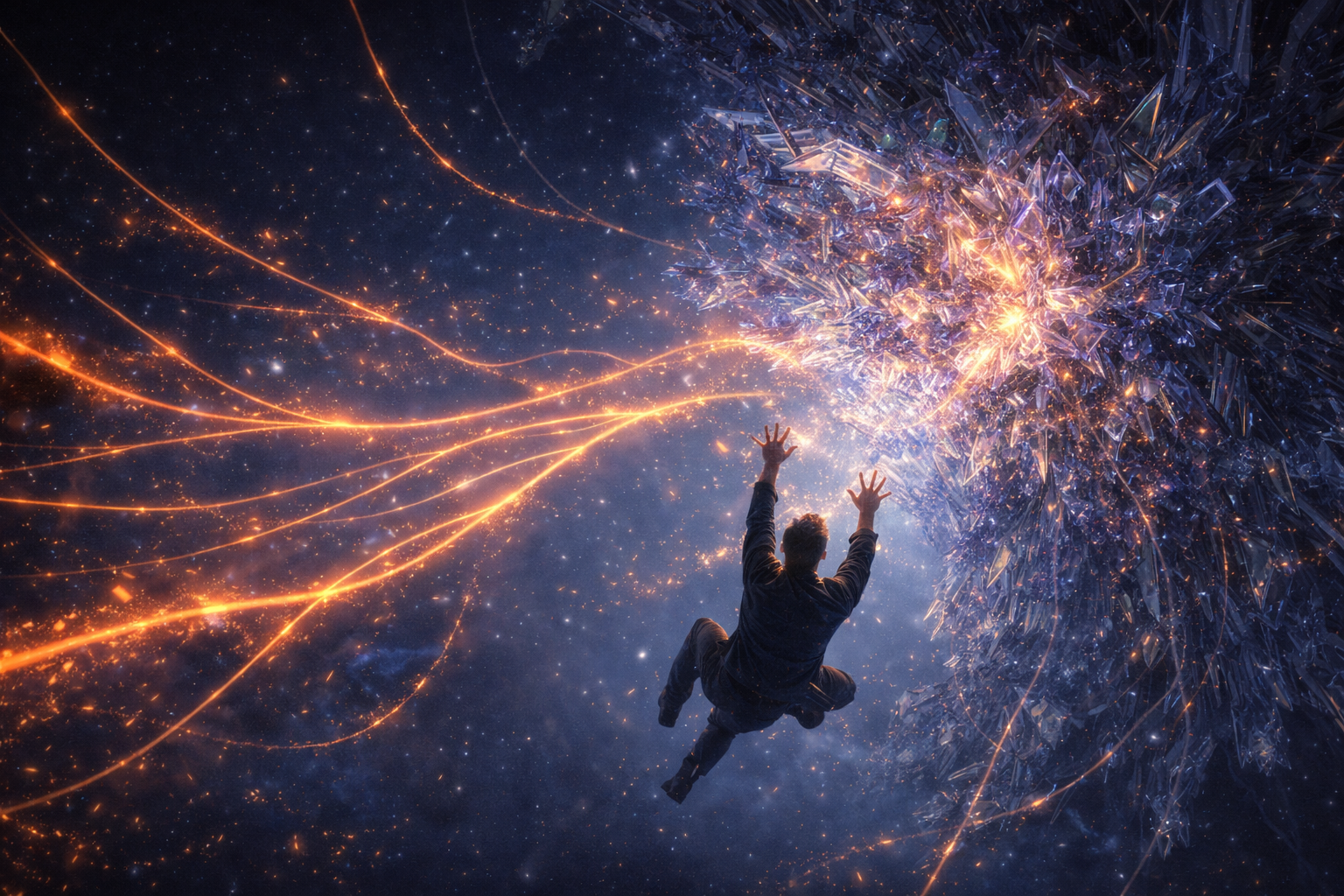
Something was wrong with the rush. Wesley had been intervening for long enough that the rhythm should have been reliable — widen the space, feel the wind return to the leaves, move on. But the rush was arriving late now, and underneath it, in the space where silence used to be, something was listening. Getting heavier with each intervention, getting closer. His perception of the timeline had started to bend around it, moments slightly distorted at the edges, the way things look through old glass. He should have stopped. He went to the next one instead.
The Enterprise. His mother’s ship. Not the one he’d served on — a later version, carrying a crew he didn’t know and a mission he hadn’t been part of. But Beverly was aboard, and the presence had reached into a moment that touched her. A junior medical officer on Beverly’s staff was about to publish research that would change how Starfleet treated a neural condition affecting thousands of officers across the fleet. Future Guy had pushed the officer toward doubt — suggesting the research was flawed, that publishing would embarrass the department, that waiting another year for more data was the responsible choice.
Wesley could see what the delay would cost. The officers who would suffer for another year while a treatment sat in a drawer because someone who wasn’t even in the room had decided the timing wasn’t right. And he could see his mother’s face in the background of the moment — Beverly reviewing the same research, about to recommend publication, about to have her recommendation undermined by doubt that wasn’t the officer’s own. He widened the space, cleared the pressure, let the officer see her own work clearly for the first time. She published. And in the moment of restoration, in that fraction of a second between the intervention completing and the wind settling back into the leaves, the presence that had been building behind every rush since the Kelvin finally crossed Wesley’s threshold of perception. Wesley saw the Entity.
It happened in the gap between action and result. The gap opened wider than it should have, and something was in it. He couldn’t hold all of it at once — edges and surfaces and depths that receded beyond his ability to follow. A structure built from consumed moments, compressed meaning, the residue of choices that had been drained of weight and absorbed into something that used weight as food. Patterns repeating at every scale, each one containing moments that had once mattered to someone and now mattered only as architecture. The worst part was how beautiful it was. Something that destroyed by being perfectly designed to destroy.
Wesley looked at it the way you look at something you’ve been feeding without knowing it was alive. It responded the way a gravity well responds — he entered its range and it acknowledged him. No intelligence, no malice. Just a vast automatic recognition that something had crossed its horizon.
His temporal perception shattered. He was built to sense moments, not the thing that ate them. His connection to the space between moments dropped, and for a fraction of a second Wesley Crusher was fully linear — blind to every other moment in the timeline, stripped of everything that made him a Traveler, reduced to a man standing in one place in one time with his mother’s ship behind him and the thing that was eating the universe in front of him. He fell.
Kore had been tracking his signature since she left. Not closely — she hadn’t been following him. But she’d kept a thread of awareness open because despite everything, despite leaving and despite being right and despite the months of searching for proof while Wesley refused to listen, she couldn’t completely let go of the person she’d spent years maintaining beside. She’d told herself the thread was practical — a safety measure. It wasn’t. It was the thing you do when someone you care about is doing something dangerous and you can’t stop them but you can’t look away either.
She’d been hunting for someone — anyone — who could give her something solid. Something Wesley couldn’t deny. Months of following leads that went nowhere, talking to scientists who dismissed her, carrying a wrongness she couldn’t prove through a world that didn’t want to hear about it. She’d doubted herself constantly — wondered if she’d walked away from the only meaningful work in the universe because of a feeling that might be nothing. The isolation of being right about something nobody believes is a specific kind of loneliness, and Kore had lived inside it for every day since she left Wesley standing in the space between moments with the argument he’d been about to make dying in his mouth. When Wesley’s signature dropped to near-zero, she moved.
She found him collapsed between moments, crumpled inside the space rather than standing in it. The area around him was distorted, curved inward toward something massive she could sense but couldn’t see — the residue of whatever Wesley had encountered, still warping the local timeline.
She pulled him to the tree. The trunk was massive and scarred and warm against his back when she leaned him into it. The wind through the leaves was the sound of a healthy timeline — layered, constant, alive.
This was home. The only home Travelers had. Wesley and Kore had sat in its branches a thousand times before, maintaining from its shelter, listening to the wind to know where moments needed attending.
But it was different now. Kore noticed it as she settled Wesley against the trunk. A branch near the top that she could have sworn was fuller the last time she was here — still green, still carrying leaves, but lighter somehow, as if the wind had to work harder to move through it. And lower down, near the roots, a section where the bark had gone smooth in a way that didn’t feel like growth. It felt like absence — like something had been worn away from the inside.
She didn’t understand what she was seeing. Not yet. But she filed it the way she filed everything — carefully, without dismissing it, ready to be examined when the framework existed to examine it. She stabilized Wesley’s temporal signature with her own, and waited.
Wesley came back slowly. The first thing he felt was the bark against his back — massive and scarred and warm, the most solid thing in a universe that had just tried to shake him apart. The second thing he felt was the wind, moving through the leaves above him, carrying the layered sound of a timeline that was still alive even though parts of it were dying. The third thing he felt was Kore’s hand on his shoulder, steady and present.
He sat against the trunk for a long time before he could speak, letting the tree hold him the way it had always held him. The place his mind had built to make the formless bearable. The one constant in thirty years of existing between everything.
And then he looked up at the canopy and saw what Kore had seen. The branch that was lighter. The section of bark that had gone smooth. Small things, easy to miss, easy to explain away. But Wesley had been sitting in this tree for thirty years and he knew what it was supposed to look like the way you know what your own face is supposed to look like, and something had changed.
He didn’t connect it to the Entity yet. Didn’t have the framework. But the wrongness that Kore had been feeling about the interventions and the wrongness that Wesley was now seeing in his own tree — those were the same wrongness, and the fact that they were the same was going to matter more than either of them understood yet.
When he could talk, he told Kore what he’d seen — something in the gap between intervention and result, something he’d been feeling the rush instead of seeing. Something that consumed meaning and used it as structure.
Kore looked at him and the tension between them — the weight of her having been right, the weight of him having not listened, the months of separation and doubt — didn’t disappear. But it shifted. Because Wesley wasn’t arguing anymore. He wasn’t dismissing what she’d felt or asking her to prove it with data. He was sitting against the trunk of their tree with his perception shattered and his certainty destroyed, and he was telling her she’d been right about everything.
She didn’t say I told you so. She told him she knew. She’d felt it well enough to stop, to walk away, to go looking for someone who could put numbers to what her gut was telling her.
She’d found someone. A Vulcan named D’Kar, a temporal physicist at the Science Academy who’d been building models that described exactly what Wesley had just experienced. His colleagues dismissed him because he had no empirical proof. Wesley was the proof — D’Kar’s equations predicted that someone like Wesley would have to exist if the degradation was real.
But D’Kar’s models were incomplete. He could measure the feeding from individual interventions but couldn’t see the full picture — every source feeding the Entity simultaneously across all of time. For that he needed observational data from something that could see the entire system at once.
Wesley knew what that ultimately meant. The Guardian of Forever. But that was a step beyond the next step. The next step was D’Kar, getting numbers for what Wesley had seen and understanding what the Entity actually was.
Wesley told Kore to take him to the Vulcan.