Chapter Four: D'Kar
Kore took him to Vulcan. Wesley’s temporal perception was still rebuilding, flickering in and out like a signal with a bad connection. Every few minutes the timeline would disappear and he’d be just a man sitting in nothing, blind to everything outside the moment he was in. Then it would come back, uneven and distorted, and he could feel the shape of the damage the Entity had left in his senses.
Kore kept him stable, held his signature together with hers the way you hold a cracked thing steady so the cracks don’t spread. She was quiet during the transit, but it wasn’t the quiet of someone with nothing to say. It was the quiet of someone deciding how much to tell.
She told him about D’Kar on the way. Not the math — she’d get to the math. She told Wesley what had drawn her to the Vulcan in the first place, because that part mattered for reasons Wesley wouldn’t understand until he met him.
What drew her to D’Kar wasn’t the math, at least not at first. It was the way his colleagues talked about him — with the specific kind of dismissal that people reserve for someone who’s asking questions they don’t want answered. She recognized that tone. Her father had used it every time she’d questioned why she couldn’t leave the house, why the outside world was dangerous, why she had to trust his science over her own sense that something was wrong with her life.
Adam Soong had raised her in a controlled environment, engineered her biology, told her the world outside would kill her, and presented all of it as protection. When she’d discovered the truth — that she was an experiment, that the danger was manufactured, that her father’s care was a leash dressed up as love — she’d burned the relationship to get free. Wesley had found her right after, alone and looking for a reason to exist that wasn’t defined by someone else’s design.
So when Kore heard that a Vulcan scientist at the Academy was being dismissed for questioning the foundations that everyone else built on — for asking whether the established frameworks of temporal mechanics were actually correct, whether the assumptions were solid, whether the thing everyone treated as settled science might be hiding something dangerous — she recognized the pattern. Someone asking uncomfortable questions and being told to stop asking. She went to see him.
D’Kar was not what she expected. Vulcans who challenged orthodoxy usually did it loudly, with the particular arrogance of someone who believed their logic was superior to the institution’s logic. D’Kar was the opposite. He followed protocol precisely. He published through proper channels. He attended every review his colleagues requested.
But the work on the displays followed a logic that no standard Vulcan analytical framework would have produced, because D’Kar wasn’t using standard frameworks. He was questioning the frameworks themselves, and he was doing it so quietly and so rigorously that his colleagues couldn’t dismiss his math — only his conclusions.
Kore had sat in his laboratory and told him what she’d felt after every intervention Wesley made. The wrongness, the too-clean restoration, the sense that something was being consumed in the fixing. She had no data, no equations, no proof. Just a feeling that she’d trusted enough to walk away from the only work that had ever given her life meaning.
D’Kar had listened the way Vulcans listen — without visible reaction, cataloguing everything. When she finished, he’d been quiet for a long time. Then he’d told her that her feeling matched his math precisely, and that she was the first person who’d ever walked into his laboratory and described from experience what his equations predicted theoretically.
Something had passed between them in that moment that Kore didn’t fully understand and D’Kar would probably never acknowledge. Two people who’d been dismissed for seeing something nobody else wanted to see, finding each other in the space between gut feeling and mathematical proof. She’d stayed longer than she’d planned. They’d worked together, mapping her experiential observations against his theoretical models, and the alignment was close enough to make Kore’s hands shake — not from fear, but from the particular relief of learning you weren’t crazy.
When she’d left D’Kar’s laboratory, she told Wesley, she’d carried two things with her: the knowledge that the wrongness was real, and the awareness that she’d met someone who thought the way she wished more people thought — from the foundations up, questioning everything, trusting nothing that hadn’t earned it.
Wesley listened to all of this and understood something about Kore that he’d missed during the months they’d worked together. He’d thought her sensitivity to the wrongness was a Traveler ability — a perceptual gift, something in her temporal mechanics that let her feel what he couldn’t. It wasn’t. It was personal. She recognized manipulation because she’d been raised by it. She felt the wrongness in corrected moments because she knew exactly what it felt like when someone rearranged your reality and called it helping.
Her father had narrowed her world and called it protection. Future Guy narrowed timelines and called it preventing suffering. Wesley widened timelines and called it restoring freedom. To Kore, they were all versions of the same thing — someone outside the moment deciding what the people inside the moment should experience.
She hadn’t left Wesley because she was overwhelmed or afraid or not ready. She’d left because she’d spent her childhood trapped in a framework that was designed for her benefit by someone who thought he knew better, and she wasn’t going to spend her adult life inside another one.
Wesley also understood, for the first time, why he’d been drawn to recruit her in the first place. Kore was a Soong — a different Soong, a different century, a different method, but the same family line that had created Data. Wesley had grown up watching Data figure out how to be a person when everything about his existence had been designed by someone else. He’d watched Data earn his humanity through choices, not through programming. And then Wesley had found Kore, another Soong creation fighting the same fight, and some part of him had recognized the echo before his conscious mind caught up.
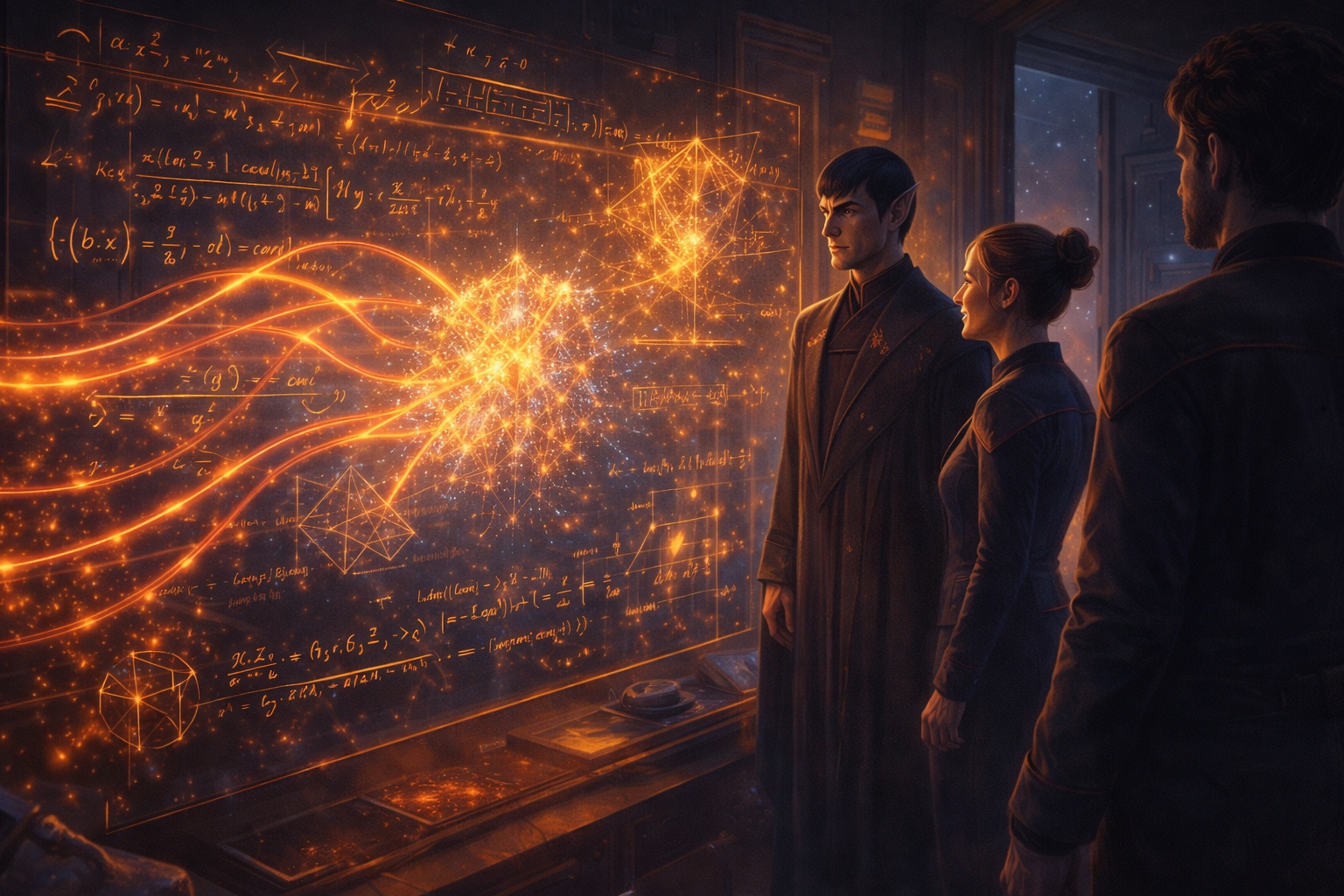
D’Kar’s laboratory was immaculate. Precise instruments, the kind of order that Vulcans breathe the way humans breathe air. And on the displays, models that didn’t fit any standard framework — equations that asked questions nobody else at the Academy wanted asked.
Wesley appeared at the threshold and waited. Kore walked past him into the laboratory like she belonged there, which she did — she’d spent enough time in this room to have earned the right to enter without invitation. D’Kar looked up from his displays and saw Kore first, and something shifted in his composure that Wesley almost missed. A micro-adjustment, barely visible, the Vulcan equivalent of someone’s face softening when a person they didn’t expect walks back into the room.
Then D’Kar saw Wesley, and the softening became something else. He stood and raised his hand in the Vulcan salute, but the way he did it carried something the standard greeting usually didn’t. There was weight behind it, as if he meant the words — live long and prosper — not as protocol but as something he was genuinely asking the universe to grant this stranger who’d just walked into his laboratory. Wesley returned the gesture, and for a moment the two of them just stood there, a Traveler and a Vulcan, taking the measure of each other across a room full of equations that described the end of everything.
Then D’Kar told Wesley that his models had predicted someone like him — a being displaced from normal causality, someone who existed outside linear time. D’Kar’s equations said that if the degradation he was modeling was real, beings like this would have to exist. Wesley was the proof he’d been waiting for. But Kore had been the first person to make him believe the proof would come.
They worked together, the three of them. Wesley described what he’d seen in the gap — the Entity, the structure built from consumed meaning, the thing that had responded to his presence and shattered his perception. D’Kar listened and built internal models as the information arrived. Kore translated between them when Wesley’s experiential language didn’t map to D’Kar’s mathematical frameworks, which was more often than Wesley would have expected. She’d spent enough time with D’Kar to know how he processed information, and she moved between the two of them with a fluency that made Wesley realize how much had happened between these two people while he’d been off breaking things.
D’Kar’s models didn’t describe the Entity as a thing — they described a process, a systematic conversion of temporal energy into something else. Every intervention released energy, and D’Kar had measured the rates from historical data and from signatures left behind by known temporal events. The Temporal Cold War factions averaged about 3.2 units of temporal distortion per event, with enormous volume over decades. The Travelers averaged 0.8 per event. Future Guy’s manipulations generated approximately 17.8.
Wesley’s interventions averaged 1.6. D’Kar explained the difference — Future Guy’s work was forceful, collapsing possibilities down to a single outcome, shoving people toward a path they wouldn’t have chosen on their own. That kind of narrowing was violent to the timeline. Wesley’s work was the opposite, widening the space back open, restoring options. A lighter touch, less disruptive per event, but still disruptive, still releasing energy, and Wesley had been doing it constantly since the Kelvin.
D’Kar showed him the full pattern. Every intervention released energy without exception. The energy accumulated in the spaces between moments, building, compounding, feeding something.
Wesley told D’Kar what he’d seen in the gap and D’Kar’s hands stopped moving over the display. He told Wesley that what he was describing matched his models precisely — the energy wasn’t just accumulating, it was being consumed by something and converted into structure. His equations predicted exactly this kind of organism, something that fed on temporal energy the way biological organisms feed on chemical energy. He’d never been able to confirm it because the organism would occupy spaces his instruments couldn’t reach. Wesley had reached those spaces, and the organism had reached back.
D’Kar asked Wesley if the structure he’d seen reminded him of anything in the known records. Wesley thought about it and found the connection — the Crystalline Entity from the Enterprise-D’s records, the organism that had consumed entire planets of organic life and left crystal lattices behind. Same family, different appetite. Where the original consumed biological energy, this one consumed temporal energy. Where the original left crystal lattices on dead planets, this one left dead spots in the timeline — moments stripped of meaning, structurally intact, completely hollow. And the Unmaker — the tendency Wesley had named at the Kelvin — wasn’t a separate phenomenon. It was the feeding trail, what the Entity left behind when it ate, the pattern of decay that spread outward from consumed moments the way rot spreads from a wound. Wesley had named the symptom at the Kelvin. D’Kar was showing him the disease. And Kore had felt it before either of them had seen it.
D’Kar’s models showed the accumulation approaching a threshold — a critical mass beyond which the feeding would become self-sustaining. The Entity wouldn’t need new energy because the accumulated mass would generate its own growth, consuming moments faster than meaning could replenish.
The growth curve was steep and accelerating. Something had pushed it past a point of no return recently, a massive spike in temporal energy that had tipped the balance. Wesley knew what the spike was — the Kelvin, his intervention, the biggest single release of temporal energy he’d ever produced. He didn’t say that out loud, but D’Kar could see it in the numbers and was too precise a scientist to pretend he hadn’t noticed.
Kore watched Wesley absorb that. She’d been watching him absorb bad news about his own actions for the last several hours and she could see the weight accumulating the same way D’Kar’s models showed energy accumulating — each new piece of information adding to a mass that was approaching its own kind of threshold.
She put her hand on D’Kar’s arm, briefly, without thinking about it. A gesture that said be careful with him without requiring words. D’Kar glanced at her hand, then at her face, and gave a nod so slight that Wesley wouldn’t have caught it if he’d been looking, which he wasn’t.
Wesley asked if there was a way to reverse the accumulation, to starve the Entity below the threshold so the feeding stopped being self-sustaining.
D’Kar told him the models were incomplete. He could show local damage, individual feeding rates, the growth curve and the threshold, but calculating whether reversal was possible required the full picture — every source of temporal energy mapped and measured simultaneously across all of time. His models extrapolated from known events. He needed observational data from something that could see the entire system at once.
Wesley asked why he couldn’t provide that himself — he existed outside linear time, he could attend to any moment in history.
D’Kar told him that was the problem. Wesley could attend to moments but he moved through them, experienced them in sequence even if the sequence wasn’t linear. He could visit any point in time but he couldn’t see all points simultaneously. He was inside the system. What D’Kar needed was a view from the boundary — not someone who traveled through time, but something that stood where time opened and could show the complete map without moving through it.
Wesley knew exactly what could see the complete map. He’d known about it his entire career as a Traveler — something ancient, something that stood at the boundary of all time, something that didn’t move through the timeline but existed where the timeline opened. He knew what it was and he knew where to find it.
D’Kar told Wesley to bring back the full scope data and he could run the complete model. The math would tell them whether reversal was possible, and if so, what it would cost.
Before they left, D’Kar gave Wesley a data module — a Vulcan device calibrated to his models, designed to interface with temporal phenomena and capture structural information that Wesley’s perception alone couldn’t hold precisely enough for mathematical analysis. He told Wesley to activate it in the presence of whatever he was going to find at the boundary, and let it record everything.
D’Kar handed the module to Wesley but looked at Kore when he said to be careful with it. He wasn’t talking about the module.
Wesley looked at Kore. She nodded once, and they left Vulcan with D’Kar’s numbers and a destination.