Chapter Thirteen: The Tree
After Jake, Wesley went looking for the light. He’d seen it once before — back at the beginning, when he was tracing the Unmaker’s fingerprint through the places where the timeline was losing weight. Everywhere he looked the branches were thinning, the leaves going grey, the wind dying in one section after another. But there had been one moment that held. One branch where the leaves still moved, where the weight refused to drain, where something about the moment itself was too real to be consumed. A planet called Xenex. A rebellion. A young commander executing someone he loved because the cause required it.
Wesley hadn’t understood why that moment held weight when everything around it was failing. He’d noticed it and moved on because he’d had bigger things to deal with. Now, with Beverly’s voice still in his ears and D’Kar’s math carved into his chest and nothing left to deal with except the thing he was about to do, he went back to find it.
The moment was still there. Still holding. Wesley could feel it from a distance — a section of the tree where the wind still moved strongly, where the leaves were green and full, where the branch carried its weight the way branches are supposed to carry weight. Everything around it was thinning but this moment sat in the middle of the decay like a heartbeat that refused to stop.
He went to it and found the young commander. Barely more than a boy. Standing over a man who was kneeling with his hands bound, waiting for something they both knew was coming. The commander’s hand was steady on the weapon but his eyes carried everything his hand wouldn’t show — the full cost of what he was about to do, held and considered and not looked away from.
Wesley watched the commander and understood why this moment wouldn’t break. It wasn’t the action that gave it weight. It was the consideration. This young man wasn’t just executing someone. He was carrying every gram of what it meant, feeling the cost before he paid it, refusing to pretend it didn’t hurt. The moment held because the person inside it held it — through nothing but the honest weight of being fully present in the worst thing he’d ever done.
Wesley needed that. Needed to be near someone who carried weight the way this man carried it, because Wesley was about to carry something heavier than anything he’d ever held, and he didn’t know how to do it alone. He stepped into the moment, paused it, and pulled the young commander aside.
The commander’s eyes went wide when the world stopped around him. The wind on Xenex froze, the dust hung in the air, and a stranger was standing in front of him who hadn’t been there a second ago.
Wesley didn’t explain what he was or how he’d gotten there or what was happening to the timeline. He told the commander his name was Wesley and that he needed somewhere to sit for a while, and he asked if the commander would come with him.
The commander looked at Wesley the way a person looks at someone they can tell is carrying something unbearable — not with understanding, because he couldn’t understand, but with the recognition of weight. One person who was about to do the hardest thing in his life looking at another person who was about to do the same. He said yes.
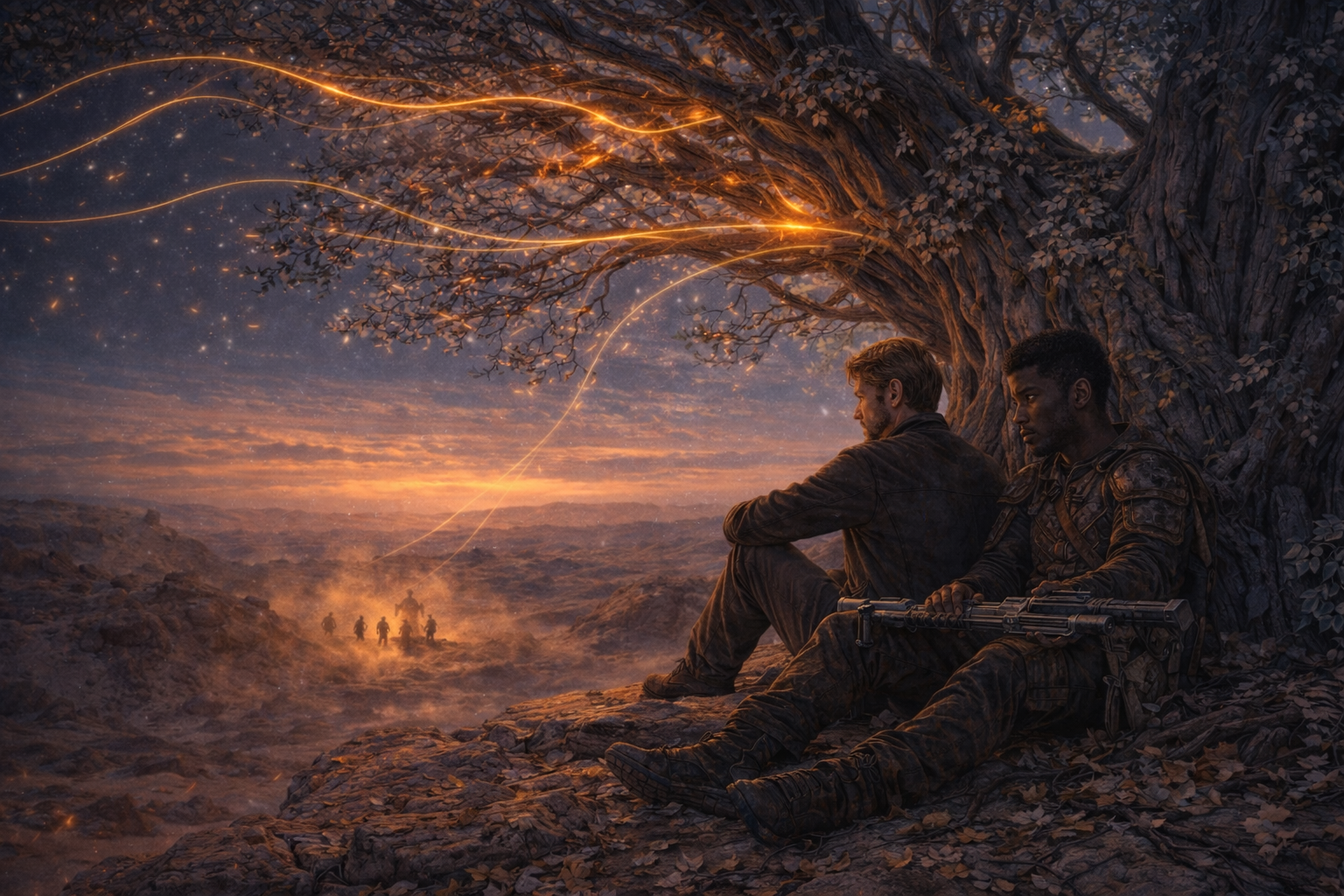
Wesley brought him to the tree. The commander had never seen anything like it and Wesley didn’t try to explain it in terms that would make technical sense. He told him this was where he lived, the only place that had ever been home, and that it would make more sense the longer he sat in it.
They climbed to a broad branch where Wesley had sat a thousand times before and the commander settled against the trunk and looked out at what was spread around them — the whole structure of time visible to him for the first time, alive and growing and, in places, dying.
The commander could feel it. Wesley watched the moment it registered — the young man’s hands going still, his breathing changing, his body recognizing something his mind hadn’t caught up with yet. The timeline was flowing through him. Not painfully, not overwhelmingly. The way water flows around a stone in a river — present, constant, something you feel against your skin without being harmed by it.
The commander sat with it for a long time without speaking. Not because he had nothing to say but because he was doing what Wesley had watched him do at the execution — considering. Taking the experience in fully instead of rushing to a response. Letting it be what it was before deciding what it meant. Wesley had never met anyone who did that as naturally as this man did.
They stayed for days. Time didn’t work the same way in the tree — a day inside it could be a second on Xenex or a century, depending on things Wesley had never fully understood and had stopped trying to. What mattered was that the days felt like days, and they spent them the way two people spend time when one of them needs to talk and the other is the rare kind of person who knows how to hear what’s actually being said.
Wesley talked. He told the commander about growing up on the Enterprise. About his mother running sickbay and his absent father and the crew that became his family — Geordi’s late-night engineering, Data’s quiet dignity, Picard’s impossible standard. He told him about the Traveler, about leaving Starfleet, about the choice to step outside of time and maintain instead of live.
He told him about thirty years of holding the rule while the timeline suffered around him. About the Kelvin fracture, the moment he broke, the way it felt to seal the rift and hear the wind come back through the leaves and believe he’d done something right.
He told him about the spree. About the Entity in the gap, the thing that was feeding on every intervention he’d ever made. About D’Kar’s math showing Wesley was part of the equation and the Guardian’s map showing his work on the same feeding lines as Future Guy’s.
And he told him about Kore. Not just her role in the story — her leaving, her wrongness, her coming back. The things Wesley had never said to anyone, including Kore herself. That finding her on Earth had felt like finding the last person in the universe who might understand what he was carrying. That recruiting her wasn’t just about the work — it was about not being alone anymore. That watching her leave had broken something in him he’d pretended wasn’t broken, and that her coming back hadn’t fixed it because the break wasn’t about her absence, it was about knowing she’d been right to go. That what he felt for her didn’t fit any word he knew — not love the way people usually meant it, not friendship, not partnership. Something deeper and less defined that had to do with the specific experience of being two people who existed in the same impossible space and chose each other’s company inside it. He told the commander these things because he was about to die and he’d never told anyone and he didn’t want to go through the Guardian carrying them unsaid.
He told him about Sisko and the gumbo and what it cost to watch your son destroy the timeline and choose not to stop him. About Jake, who turned out to be the shadow Wesley had been fighting for years — a broken kid who loved his father too much and pointed every gift he had at the universe and tried to make it stop hurting. Wesley told the commander that Jake was the first person who’d ever made him feel less alone in a different way than Kore did — not the loneliness of existing outside time without a companion, but the loneliness of carrying a compulsion nobody else understood. Jake understood it because Jake had the same one. Sitting with Jake in the ruins of the Andorian moment, neither of them trying to fix anything for the first time in either of their lives, had been the closest Wesley had come to peace since before the Kelvin. And he told the commander he’d seen Jake again, just hours ago — on a Deep Space Nine a hundred years past Jake’s childhood, in the quarters that had been Jake’s at sixteen, telling Jake the math face to face. That Jake had taken it the way Beverly had taken it. That he didn’t know what Jake was going to do with what he’d been told, and he wasn’t going to interfere with whatever Jake decided.
He told him about Beverly. About standing in sickbay invisible while his mother said his name to an empty room, and then going back and appearing to her fully — solid, real, her son standing in front of her for the first time in thirty years. About watching her hold together while he fell apart and knowing she was stronger than he’d ever been. About the sound she made after the door closed, the sound he heard because he hadn’t left yet, the sound of a woman whose strength finally ran out in the privacy of an empty room. He told him what D’Kar’s math said he had to do. And that he was terrified.
The commander listened the way he did everything — fully, carefully, with the consideration that made his moment on Xenex the one point of light in a greying timeline.
He didn’t try to fix Wesley’s problem or offer solutions or tell him there had to be another way. He’d spent his own life making impossible choices and he knew that when someone tells you the math says they have to die, the right response isn’t to argue with the math. It’s to sit with the person. So he sat with Wesley. And he talked too.
About Xenex — not the rebellion the way history would record it, but the way a kid lived it. About being fourteen when his father was killed by the Danteri and deciding that same night that the occupation would end because of him. Not out of strategy or politics — out of fury. About learning to turn fury into something people could follow, which meant learning to carry it instead of swinging it. About the fighters who trusted him because he was the one willing to go first into anything, and the ones who trusted him because he was the one willing to sit with them the night before and not pretend it wasn’t terrifying.
He told Wesley about growing up in a war, about never having the luxury of a normal childhood, about watching friends die beside him and not being allowed to stop because the people still alive needed him to keep going. About the specific loneliness of being the person everyone looked to — the one who couldn’t break down because if he broke, the whole thing fell apart. Wesley recognized that immediately. Different war, different scale, same weight.
The commander talked about D’n’rai — not the execution, the man. His teacher, his surrogate father, the person who’d taught him how to fight and how to think and how to tell the difference between a battle worth dying for and a battle worth walking away from. He told Wesley that D’n’rai used to say the hardest thing a leader does isn’t deciding to fight — it’s deciding what fighting costs the people who follow you, and carrying that cost yourself instead of passing it down.
Wesley sat with that for a long time because it sounded like something Sisko would say, and something Wesley had spent thirty years failing to learn.
The commander asked Wesley about Picard — he’d heard of Picard, the Federation captain whose reputation had reached even Xenex. Wesley told him about serving under Picard as a teenager, about the impossible standard the man set just by being in the room, about learning more from watching Picard sit in a chair and make a decision than most people learn in a lifetime of study. The commander listened with the particular intensity of a young man who wanted to be that kind of leader and wasn’t sure he knew how. Wesley told him he’d get the chance. Didn’t say more than that.
They listened and recognized something familiar in each other — two people built the same way, carrying different weights. And the commander asked questions. Not temporal mechanics questions — human questions. What did Beverly look like when she saw you? What did the gumbo taste like? What does Kore sound like when she’s angry? The questions of a person trying to know another person, not a student trying to learn a subject.
Wesley answered them all. And somewhere in the answering — in describing Beverly’s grey hair and the cayenne in Joseph’s recipe and the way Kore’s voice went flat when she was furious because anger for her was the opposite of volume — Wesley realized he was doing something he hadn’t done in thirty years. He was being known.
Not understood, not analyzed, not evaluated. Known. The way you know someone when you’ve sat with them long enough and asked the right questions and listened to the answers without an agenda. The commander knew Wesley now — not because of the quantum connection or the temporal mechanics, but because he’d spent days in a tree with a man who was about to die and he’d cared enough to ask what his mother looked like.
On the last day — or what felt like the last day, before the weight of what was coming became too heavy to sit with any longer — the commander asked Wesley one question that Wesley hadn’t expected. He asked Wesley what the tree sounded like to him.
Wesley told him. The wind through the leaves. The layered, constant, living sound of a timeline carrying weight. How it sounded when it was healthy — full, rich, the rustle of a billion moments connected to each other. How it sounded when it was dying — thin, patchy, sections going still. How it sounded right now — damaged, struggling, still alive but losing ground.
The commander closed his eyes and listened. Wesley watched the young man’s face and could see his eyes moving beneath his eyelids, slowly, tracking something invisible, following the sound of the wind the way you follow a melody when you’re trying to learn it by ear. The movement was rhythmic — in time with the leaves, in time with the branches, as if the commander’s body was aligning itself with the tree’s pulse without being told how.
Wesley understood then why he’d come here. Why this moment held weight when everything else was failing. Why this man, out of everyone in the timeline, was the one whose branch wouldn’t break.
Because Mackenzie Calhoun didn’t just hear things. He let them in. And in a universe being destroyed by people who acted on things without ever letting those things in first, that quality was the rarest and most necessary thing left.
Wesley returned the commander to his moment on Xenex. The wind unfroze, the dust moved again, and the man with bound hands looked up at his commander with the calm acceptance of someone who’d already made peace with what was coming. The commander looked down at the weapon in his hand and Wesley could see the difference in his eyes — the same consideration that had been there before, but deeper now, carrying something it hadn’t carried before. Days of conversation, a tree between worlds, the sound of wind through leaves. All of it stored somewhere underneath the immediate weight of what he was about to do. The commander acknowledged what his mentor meant to him. Considered the cost. Then paid it.
Wesley watched from outside the moment and felt the branch hold. Stronger than before, if anything. Whatever he’d given this young man in those days together — the story, the sound of the tree, the experience of being fully inside the timeline’s structure — it had added to the weight that was already there. The moment that refused to break was carrying more now, not less.
Wesley left. Behind him, the quantum connection between them settled into permanence — not because of a technology or a device or a Vulcan data module, but because two people had spent days together in a tree and one of them had considered everything the other said, and that kind of connection doesn’t dissolve just because the people are separated.
The information Wesley had shared settled into Calhoun — not as conscious memory but as something deeper, held in the same place where the sound of the wind through the leaves was held.
Wesley didn’t know any of that. He just knew he’d spent his last days as a person with someone worth spending them with, and that was enough.
He went to find Kore.